
Short answer first: a coop camera is really three different tools wearing one name. It is a predator detective — the camera that tells you at 2 a.m. whether the shape circling your run is a raccoon, a fox or the neighbor’s cat. It is a laying check — a quiet eye inside the coop that shows you who is sitting in the favorite nesting box and whether the new pullets have started laying. And it is a holiday sitter — the live view that lets you check on the flock from a hotel room while somebody else does the feeding. Different jobs want different cameras, so the picks below are split by job on purpose. One deal-breaker comes before all of them, and almost nobody mentions it: how far is your coop from your house Wi-Fi? Most coop camera disappointment is not a bad camera. It is a good camera mounted forty feet past the edge of the router’s reach.
Every pick below was chosen from manufacturer specs and the patterns that show up again and again in verified owner reviews — we do not claim to have mounted all of these over our own run, and you should be skeptical of any site that claims it tested thirty cameras on one coop. What we did instead: matched each camera to the job it actually does well, and paid close attention to the complaints owners repeat, because at a chicken coop the weaknesses show up fast. Dust, distance and darkness are the three tests, and a camera that survives your hallway can fail all three by Friday.
Quick Picks: The Short Version
| Camera | Type | Power | Connection | Night vision | Best for |
|---|---|---|---|---|---|
| Reolink Altas PT Ultra | Solar pan-and-tilt security camera | Rechargeable battery + solar panel | Wi-Fi (2.4 and 5 GHz) live view | Full-color night vision, no spotlight | Watching the run live and identifying night visitors |
| Blink Outdoor 4 (2 Camera System) | Fixed battery security cameras | 2 AA lithium batteries per camera | Wi-Fi via the Sync Module hub indoors | Infrared night vision | One camera inside the coop, one outside, with the least upkeep |
| Tactacam Reveal X 3.0 | Cellular trail camera | 12 AA batteries | 4G LTE cellular — photos to your phone, plan required | Low-glow infrared flash | Coops and pastures with no Wi-Fi at all |
Notice the connection column, because it decides more than the camera does. If your phone shows a healthy Wi-Fi signal standing at the coop door, all three types are in play. If the signal dies halfway down the yard, the first two picks will frustrate you no matter how good their lenses are — skip to the Wi-Fi section below, or straight to the cellular pick.
1. Reolink Altas PT Ultra — Best for Watching the Run
This is the camera for the predator detective job. The Altas PT Ultra is a 4K pan-and-tilt camera — 355 degrees of pan, 90 of tilt — with auto tracking, so when something crosses the run at night the camera follows it instead of recording the fence post it started on. Its ColorX night vision is the feature that matters most at a coop: it records in color after dark without a visible spotlight, so the night visitor on your footage has markings, not just a grey silhouette. Raccoon or stray dog is a distinction worth having. It runs on a large rechargeable battery kept topped up by the included solar panel, records to a memory card locally, and — owners mention this a lot — asks for no monthly subscription to do its main job.

- 4K pan-and-tilt camera (355° pan, 90° tilt) with auto tracking that follows whatever moves across the run
- ColorX night vision records in color after dark with no spotlight, so a raccoon’s markings stay readable on the footage
- Battery plus included solar panel — Reolink rates it at up to 500 days per charge in standard mode — and it records to a memory card locally, no subscription required
What we like:
- The color night footage. Owner reviews repeat it: this is the camera people buy after a cheaper one showed them a grey blur and called it evidence
- It pans, tilts and tracks. One camera covers a whole run corner to corner, instead of a second fixed camera for the blind spot
- Solar plus local recording ends the two usual chores — no battery runs to the coop, no subscription between you and your own footage
What holds it back:
- It is still a Wi-Fi camera. Dual-band helps — 2.4 GHz reaches noticeably further than 5 GHz — but a run beyond your router’s reach is beyond this camera
- Auto tracking makes the motor work for a living, and owners who enable every smart feature report the battery draining faster than the headline figure suggests. The panel needs real sun to keep up
- It is the biggest unit here, and the panel wants a sunny mounting spot — not always the shady corner where the coop sits
Not for: coops out of Wi-Fi range, or deeply shaded runs where the panel would starve. For: the keeper whose coop is within honest Wi-Fi reach and who wants to know exactly what visited last night — not just that something did.
2. Blink Outdoor 4 — Best Inside-and-Outside Pair
The Blink takes the opposite approach: no pan, no zoom, no drama. This two-camera system pairs two small fixed 1080p cameras with a Sync Module hub that lives indoors, near your router. That split is exactly why it works so well at a coop. Put one camera inside the hen house aimed at the nesting boxes — your laying check — and the second outside watching the run door. Each camera runs on two AA lithium batteries that Blink rates at up to two years at default settings, so the inside camera is not a weekly chore. Infrared night vision, two-way talk, and an app your family may already know from the doorbell version.

- Two wire-free 1080p cameras plus the Sync Module Core hub — one for the nesting boxes, one for the run, nothing to wire
- Each camera runs on 2 AA lithium batteries, rated by Blink at up to two years per set at default settings
- Infrared night vision, two-way talk and Alexa support; the cameras talk to the hub indoors, which is kinder to weak yard Wi-Fi than most
What we like:
- The battery life is the whole pitch, and it delivers. Owners consistently rank it the camera they forget about — which at a coop is the highest praise there is
- Two cameras change the questions you can answer. Not “is something wrong?” but “is the problem inside the coop or outside it?” — the nesting-box camera alone settles egg-eating suspicions in a weekend
- Setup genuinely takes minutes: hub inside, cameras wherever the screws land, no cables to bury
What holds it back:
- It records motion clips, not a continuous stream — fine for checking events, limited if you want to watch a whole evening unfold
- The included Sync Module Core has no local storage: saving clips to the cloud needs Blink’s optional subscription plan, and extras like person detection live behind that plan too
- Fixed cameras do not follow anything. Aim is everything, and a raccoon working the far corner of a big run can stay out of frame — place the hub on the coop side of the house to give it the best range
Not for: anyone wanting continuous recording or a camera that tracks movement across a large run. For: the holiday sitter and the laying check — keepers who want two simple views of the flock, from anywhere, with batteries they change about as often as the coop’s calendar.
3. Tactacam Reveal X 3.0 — Best Where There Is No Wi-Fi
When the coop sits past the end of the garden — down by the pasture fence, out at the barn — Wi-Fi cameras are not a worse choice, they are no choice at all. That is the job cellular trail cameras were built for, and the Reveal X 3.0 is the one hunters and landowners reach for most. It ignores your router completely: motion triggers it, it takes 4K still photos or 1080p video, and it sends them straight to the Tactacam app over 4G LTE, automatically picking the strongest carrier signal where it stands. The low-glow infrared flash reaches well across a run without spooking wary animals, and storage is internal — no memory card to hike out and swap. The honest trade: it is a photo sender, not a live-view camera, and the photos only reach your phone on a paid data plan, the way a phone itself does.

- Cellular, not Wi-Fi: sends motion photos and 1080p video straight to your phone over 4G LTE — it works wherever a phone signal does
- Auto-connects to the strongest carrier signal on site, takes 4K stills, and its low-glow infrared flash does not spook animals
- Runs on 12 AA batteries with internal memory, so there is no card to swap; a paid data plan is required for photos to reach the app
What we like:
- It simply works where the other two cannot. If your phone has a bar of signal at the coop, this camera has a connection — no extender, no hub, no trenching cable
- It was designed by people who leave cameras outdoors for months. Weather sealing, a fast trigger and a flash animals barely notice are trail-camera basics that coop duty uses exactly as hard
- The evidence arrives on your phone by itself. After a bad night, the visitor’s portrait is already in the app — which is half the value of our guide on what is killing your chickens: identify the culprit correctly before you respond
What holds it back:
- No plan, no photos. The monthly data plan is part of the true cost of every cellular camera, and this one is no exception — budget for it as part of the purchase, not as a surprise in week three
- It is a stills-first camera. You get excellent triggered photos and clips, not the open-the-app-and-look-around live view the two Wi-Fi picks give you
- A busy run eats batteries and data alike. Twelve AAs in a high-traffic spot will not last the season, so aim it at the gate and the fence line, not the dust bath
Not for: in-town coops with strong Wi-Fi (you would be paying a plan to solve a problem you do not have), or anyone who wants live viewing. For: remote coops, pasture pens and barn setups where the question was never which Wi-Fi camera — it was whether any camera could work out there at all.
The Wi-Fi Problem and How People Solve It
Here is the test that decides everything, and it takes ninety seconds: walk to your coop with your phone, stand where the camera would mount, and check the Wi-Fi. Two bars or better, and any camera in this guide will behave. One bar, or a connection that drops when you shift your weight, and you are shopping for signal first and a camera second. Owners solve this four ways, in the order most people end up trying them.

- Move the router, not the coop. The cheapest fix in networking: the router belongs on the coop side of the house, near a window with line of sight down the yard. Walls eat more signal than distance does
- Use the hub trick. Systems like the Blink keep their hub indoors and talk to their cameras on their own long-range link — one reason hub systems keep working in yards where a lone Wi-Fi camera gives up
- Add an outdoor extender or access point. A weatherproof access point on the back wall of the house, or a mesh node in a window, pushes honest Wi-Fi across most suburban yards. This is the permanent fix if the coop is a fixed address
- Skip Wi-Fi entirely. Where the yard is measured in acres, cellular wins by default — a trail camera on the fence post, or a cellular security camera where live view matters
One more thing owners learn the expensive way: set the camera up at the kitchen table before it goes outside. Pair it, update it, name it. A camera that will not cooperate is a five-minute job indoors and a forty-minute ladder job at the coop in February.
Power at the Coop: Battery, Solar or Mains
Most coops have no outlet, which quietly makes power the second decision after signal. The three options, honestly:
- Battery is the default for a reason: mount the camera anywhere, change batteries on a schedule you choose. Long-life designs like the Blink sip power by recording clips; hungry designs with tracking motors drink it. Know which kind you bought
- Solar is the upgrade that removes the chore — a small panel keeps a rechargeable battery topped up indefinitely in decent sun. It fails in exactly one situation, and it is a common coop situation: deep, all-day shade. A panel under a big oak is a decoration
- Mains power is the best option nobody counts, because most owners assume they do not have it. If your coop stands near a shed or garage with power — or you already ran a cable for an automatic door or a winter water heater — a plugged-in camera never sleeps and records continuously. Worth one look at the yard before you rule it out
Whatever you choose, mount the camera under the eave or a small overhang where you can. A sheltered lens is the difference between night footage and night fog once the ice starts forming.
What a Camera Will Not Do
Now the section that keeps this guide honest. A camera records the raccoon. It does not stop the raccoon. The best coop camera ever made is a witness, not a lock — it will show you, in lovely color, exactly how the visitor got in, and that footage only saves hens if it sends you out the next morning to fix the gap it revealed. Owners who get real value from coop cameras treat them as the second layer, never the first. The first layer is the boring physical stuff in our guide to how to predator proof a chicken coop: hardware cloth, two-step latches, a buried apron, a door that closes itself.
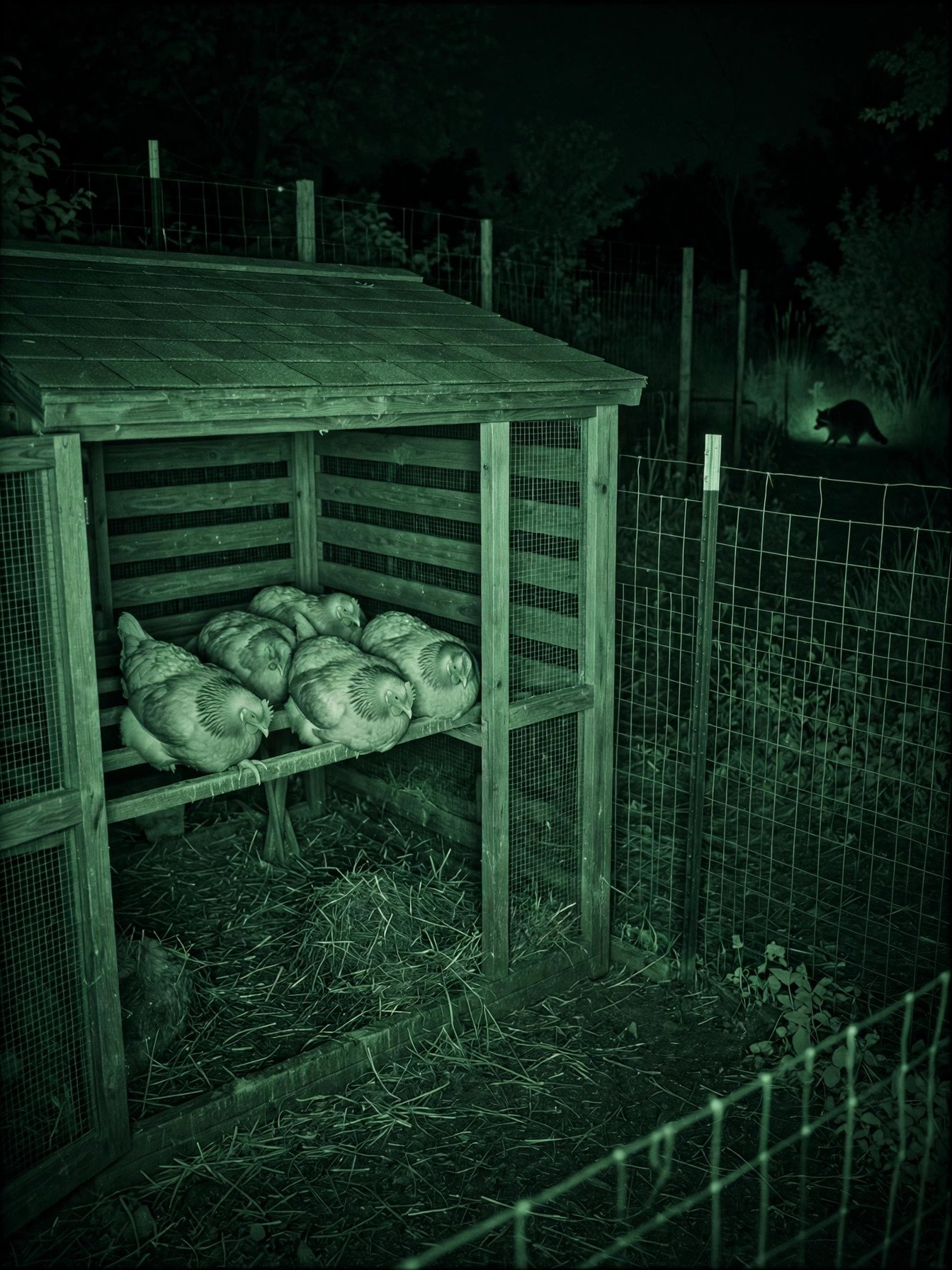
Used that way, though, a camera earns its place three times over. It tells you which predator you are actually fencing against, so you stop reinforcing against foxes when your problem climbs like a raccoon. It tells you whether last night’s fix held. And paired with one of the best automatic chicken coop doors, it closes the loop on the whole night shift: the door locks the flock in at dusk, and the camera confirms from your phone that every hen made it inside before it did. That confirmation, from a warm kitchen, is the thing owners say they would not give back.
Frequently Asked Questions
Can I put a camera inside the chicken coop?
Yes — most keepers who try it keep it. A small battery camera aimed at the nesting boxes shows who is laying, who is sitting broody and whether anyone is eating eggs. Expect dust on the lens; wipe it when you collect eggs. Keep it out of direct pecking range — hens investigate anything new with the only tool they have.
How far from the house can a Wi-Fi coop camera be?
There is no honest single number, because walls matter more than distance. In open air with line of sight, home Wi-Fi often reaches 100 feet or more; through two exterior walls it can fail at 30. Use the phone test from the Wi-Fi section above — your phone at the mounting spot is a better measuring tool than any figure on a box.
Do coop cameras need a subscription?
It depends on the type. Solar cameras that record to a memory card, like the Reolink above, do their main job with no plan at all. Hub systems like Blink keep basic alerts free but charge for cloud clip storage and smart detection. Cellular trail cameras always need a data plan — no plan, no photos on your phone. Read the plan terms as part of the price, every time.
Will a camera scare predators away?
No. A camera’s lights and the odd two-way-audio shout may startle a first-time visitor, but raccoons habituate to novelties quickly. Treat the camera as your evidence gatherer and early warning, and let hardware cloth, latches and a self-closing door do the actual defending.
The Bottom Line
Pick the job first, then the camera. For the predator detective with Wi-Fi in reach, it is the Reolink Altas PT Ultra — color night footage, a lens that follows the action, and no subscription rent. For the laying check and the holiday sitter, the Blink Outdoor 4 two-camera system puts one eye inside the coop and one outside, then leaves you alone for seasons at a time. And where the yard outruns the Wi-Fi, the Tactacam Reveal X 3.0 does not care about your router at all. Whichever you mount, run the ninety-second phone test at the coop first — and remember the camera’s real job is to show you the hole in the fence while there is still daylight to fix it.