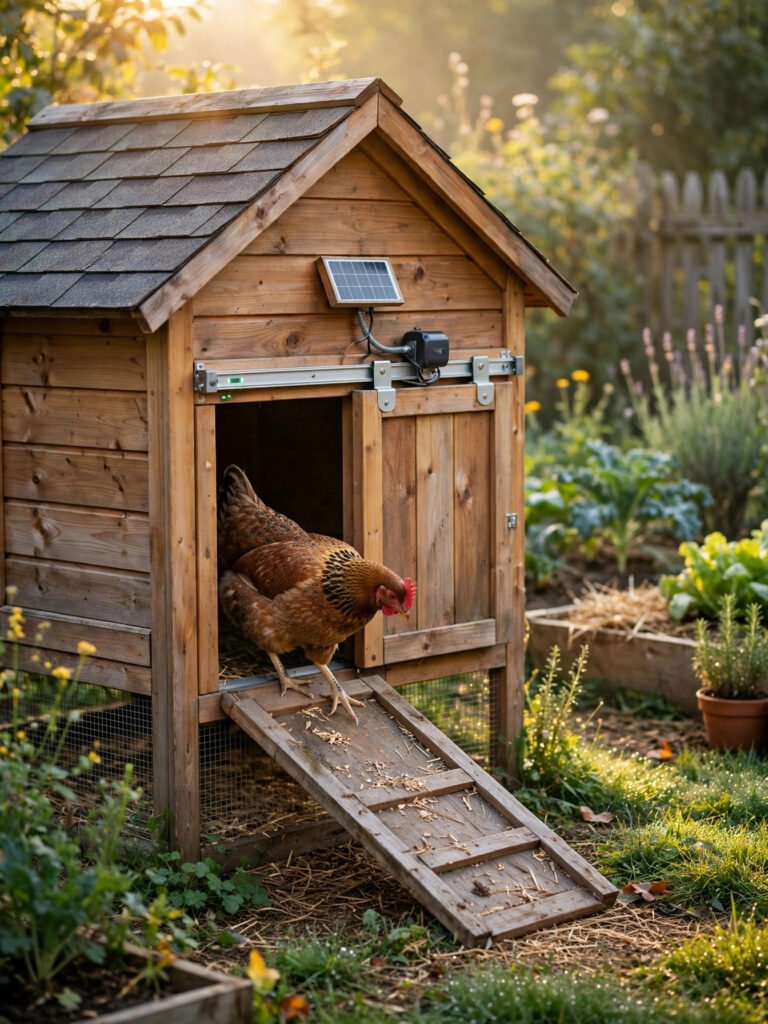
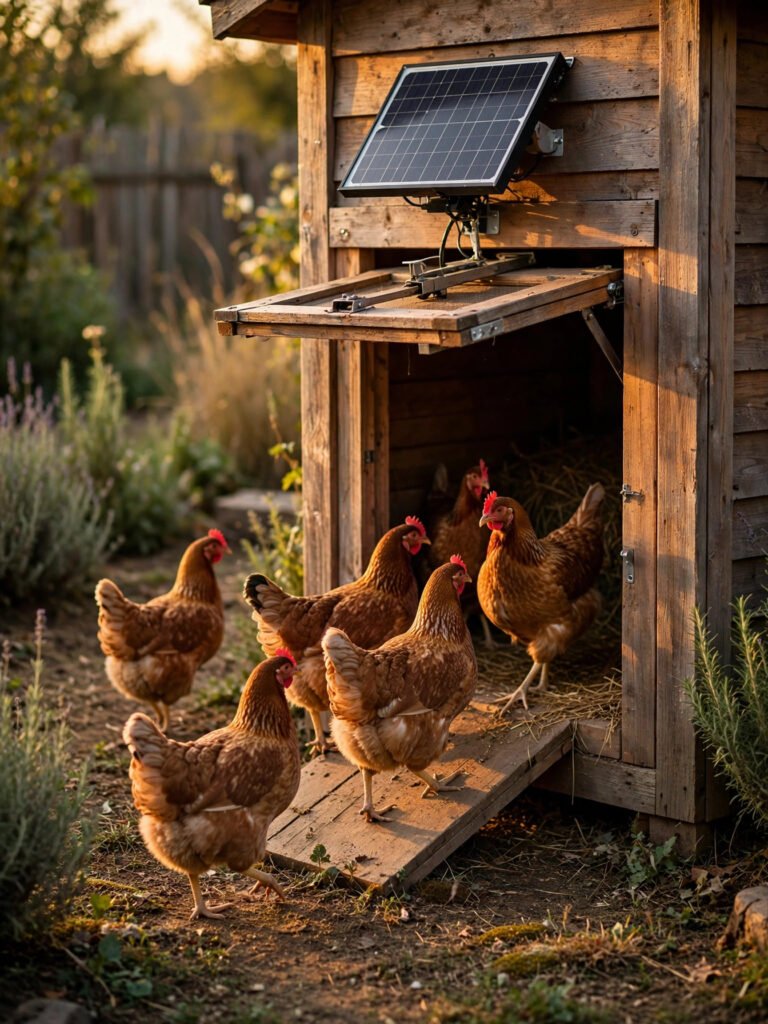

Short answer first: both solar and battery automatic coop doors work — what decides between them is not the door, it is your coop. A solar door fed by a small panel needs real sun on that panel, in winter too. A battery door needs nothing from the sky, but it runs on a battery somebody has to remember. Put a solar panel on a shaded coop at a northern latitude and it starves slowly all winter. Forget a set of AAs for a year and the door fails the same quiet way. Pick the power source that matches your yard and your habits, and either one will run for years.
This comparison is built the way everything on this site is built: from manufacturer specs and the patterns that repeat in verified owner reviews. We do not claim to have run these doors side by side through a winter, and you should be suspicious of any site that claims it did. What the specs and the owner reports agree on is below — including the part of the solar story the listings leave out.
Solar vs Battery at a Glance
| Power source | How it charges | Winter reliability | Shade tolerance | Ongoing chore | Failure mode | Best for |
|---|---|---|---|---|---|---|
| Solar | A small panel tops up an internal rechargeable battery | The weak point — short days, low sun and snow on the panel all cut charging | Poor. The panel needs direct sun, even if the coop itself sits in shade | Keep the panel clean, clear snow off it, check the cable run | Slow and silent — the reserve drains over cloudy weeks until the door stops | Sunny, open yards, especially off-grid coops far from the house |
| Battery | It does not — you swap AAs or recharge a built-in pack on a schedule | Strong. Cold trims battery capacity a little, but the reserve is months long | Total. The coop can sit under trees all day | Swap or charge batteries once or twice a year — and actually remember | Silent — a flat battery leaves the door stopped wherever it was | Shaded yards, northern winters, and anyone who wants zero install beyond the door |
| Mains with battery backup | The outlet does the work; the battery only covers power cuts | Strongest of the three | Total | Almost none | Rare — needs both a power cut and a flat backup | Coops close enough to the house to run a cable to |
How Solar Doors Actually Behave
Here is the thing the listings say quietly, usually three bullet points down: almost no “solar” coop door runs directly off its panel. The panel charges a rechargeable battery inside the unit, and the battery runs the door. Solar is really solar-charged battery. That is not a criticism — it is a good design, because the door has to open at dawn and close at dusk, the two moments the panel is doing almost nothing. But it means a solar door is judged exactly like a battery door, on the size of its reserve, plus one extra question: can the panel refill that reserve where your coop actually sits?
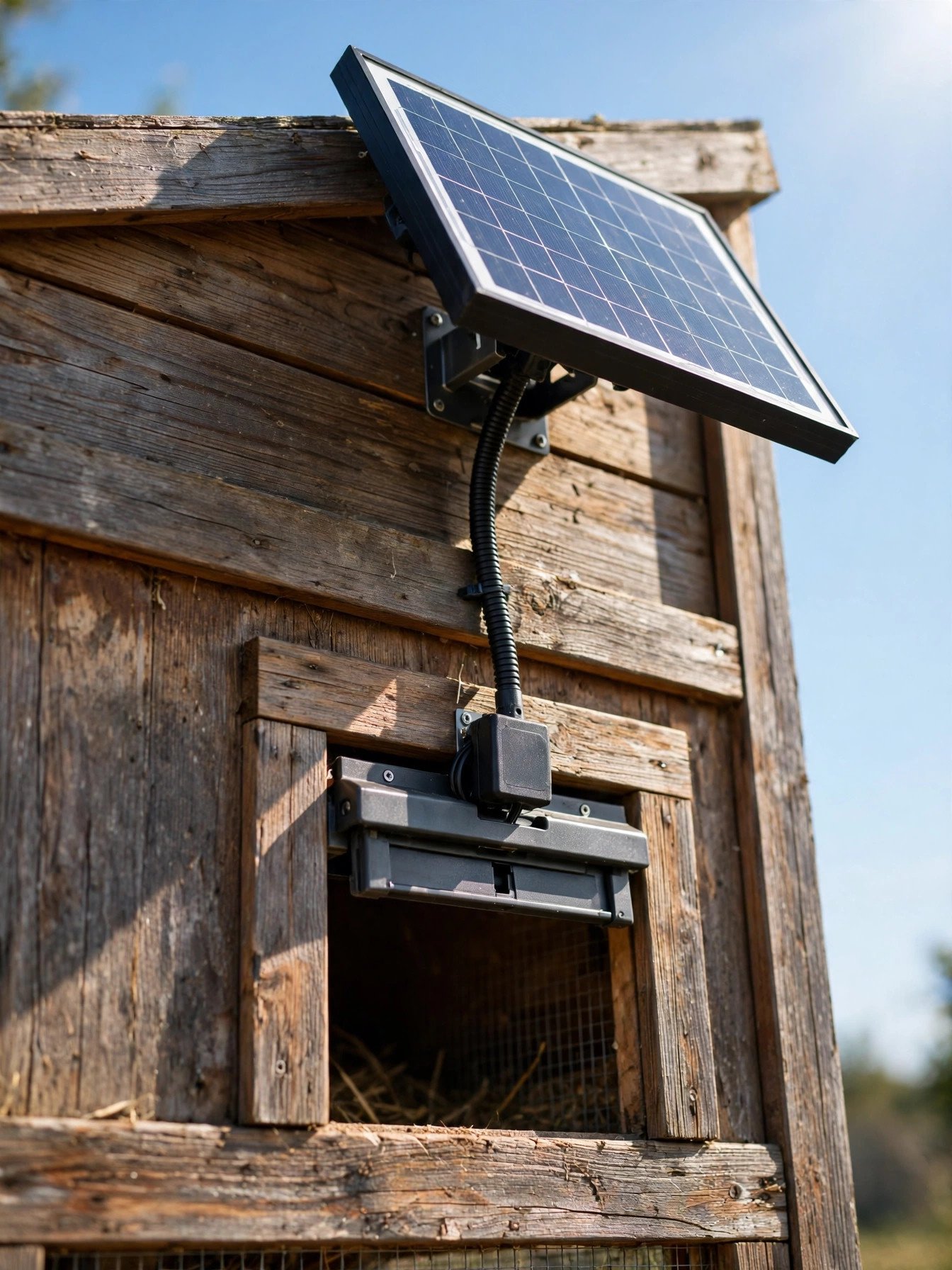
Panel size is the whole game. A door motor sips power — two short runs a day, a few seconds each — so in decent sun even a small panel replaces a day’s use quickly. The trouble is never July. The trouble is a December week at a northern latitude: the sun is up for eight or nine hours, rides low, and the panel spends half the day in the shadow of the coop itself, a fence or bare trees. Add snow sitting on the panel and charging drops to zero until somebody brushes it off. The cloudy-week math works out like this: a healthy reserve covers days of grey weather without blinking, a bad week makes a dent, and a bad month on a shaded panel runs the battery down to the point where the door simply stops one morning. Owners in sunny, open yards report the opposite problem — none at all. Same door, different sky.
Placement decides most of it. The panel wants a south-facing spot (in the northern hemisphere), tilted, out of the coop’s own shadow, on a cable run a hen cannot worry at — and it wants wiping when it gets dusty and brushing when it snows. Do that on an open yard and solar is genuinely set-and-forget: no batteries to buy, no schedule to keep. Skip it on a wooded lot and you have bought a battery door with a slow leak.
The solar example from our main doors guide makes the point neatly, because it does not hide the arrangement: the ChickenGuard runs on ordinary AAs out of the box, and the solar route is a kit you add.

- Three power options on one door: 4 x AA batteries (included in this version), ChickenGuard’s solar kit, or a 9-12V DC mains cable
- DualSafe closing — timer, light sensor, or whichever comes first — plus Auto-Stop anti-pinch, Winter Mode against ice and snow, and a 3-year warranty
- The honest catch: solar here is an add-on kit bought separately, not a different door — the panel keeps the unit’s batteries fed rather than replacing them
How Battery Doors Actually Behave
Battery doors split into two camps. AA doors run on a handful of ordinary batteries you swap when they fade — cheap, simple, and every shop on earth sells the replacements. Built-in rechargeable doors seal the battery inside the unit: nothing to swap, but charging means plugging the door in or bringing a cable to it, and when that sealed battery eventually wears out years down the line, it is a conversation with the manufacturer rather than a two-minute swap.
How long does a set last? Treat the numbers on the boxes as what they are — manufacturer claims, made in mild conditions. AA door makers commonly claim around six months per set. RUN-CHICKEN rates its built-in battery at up to a year per charge in cold climates and up to two in warm ones. Owners of the lantern-battery ADOR1 in our doors guide report roughly a year per battery. The honest pattern across all of them: you will measure your door’s appetite in seasons, not weeks, and cold weather trims the real figure below the printed one. None of that is a problem if the batteries are on a schedule — spring and autumn, same weekends you do everything else at the coop. All of it is a problem if they are not.
Because here is the battery door’s one real weakness, and solar shares it: it fails silently, and it fails in place. A dying battery does not swing the door open or set off an alarm. One dusk the door simply does not close, and unless you notice, the flock spends the night behind an open door — which is exactly the scenario our guide to how to predator proof a chicken coop exists to prevent. The fix costs nothing: a weekly glance. Walk past the coop one evening a week and confirm the door is shut, the way you would check a latch. Keepers who want that glance done remotely aim one of the best chicken coop cameras at the door and check the still image from the couch — same habit, warmer feet.
The battery example from our doors guide is the door that removes the swapping half of the chore entirely:

- Built-in rechargeable battery — no AAs to swap and no panel to mount; RUN-CHICKEN rates it at up to a year per charge in cold climates, up to two in warm ones
- One-piece weatherproof aluminum door — motor, battery and panel in a single unit, on the coop with six screws
- App timer or sunrise/sunset mode, an anti-pinch sensor that stops the door on an obstruction, and rated from -15°F to 140°F
The Third Option Nobody Mentions
If your coop stands anywhere near the house, a barn or a garage with power, there is a third answer that skips the whole argument: mains power with a battery backup. The outlet does the daily work, so there is no panel to site and no charge level to think about, and the battery sits in reserve for the one situation that stops a mains-only door dead — a power cut, which otherwise leaves the door frozen wherever it was. Doors like the Omlet Smart Autodoor run on battery or mains, and the ChickenGuard above takes a DC mains cable as one of its three options, so for many keepers the third option is a cable, not a new door.
The catches are practical, not electrical. Somebody has to run that cable — across a yard, protected from weather, mower blades and hens — and the coop has to be close enough for the run to be sane. A coop at the bottom of a long garden is exactly where solar and battery earn their keep. But if your coop already stands within extension-cord distance of a building, mains plus backup is the most reliable power on this page, and it is odd how rarely it gets mentioned.
Which One for Your Coop?
Run down this list and stop at the first line that sounds like your yard:
- Open, sunny yard, coop far from the house: solar. The panel gets its sun, there is no outlet to run to, and there is nothing to swap. Site the panel facing the midday sun and keep it brushed off in snow
- Coop under trees, or anywhere the panel would spend winter in shadow: battery. Shade is the one thing solar cannot be argued out of
- Northern winters with short, dark days: battery, or solar only with a generously sized panel and a big reserve. This is where small panels quietly starve
- You know you will forget a battery schedule: solar in a sunny yard, or mains with backup near the house. The most reliable door is the one whose chore you will actually do
- Coop within cable distance of the house or barn: mains with battery backup — the strongest setup here, if the cable run is practical
- Serious cold, whatever you choose: look for a cold rating and a winter boost mode on the door itself — power source matters less than a motor that can push through ice
And whichever camp you land in, the power source is only half the door. Closing logic, safety sensors and whether the panel can be lifted by a raccoon matter just as much — our full guide to the best automatic chicken coop doors works through all four of our picks on exactly those points.
Frequently Asked Questions
Do solar coop doors work in winter?
They work as well as their panel’s winter sun allows. In a sunny yard at a mild latitude, a solar door runs through winter without drama. Far north, on short grey days — or with snow sitting on the panel — charging can fall behind use, and the internal battery drains over weeks until the door stops. The door is rarely the problem. The sky is.
How long do batteries last in an automatic coop door?
Count it in seasons. Makers of AA-powered doors commonly claim around six months per set; built-in rechargeable doors claim a year or more per charge — RUN-CHICKEN rates its T50 at up to a year in cold climates, two in warm ones. Cold trims every one of those figures, so swap or charge on a spring and autumn schedule instead of waiting for the door to tell you.
What happens when an automatic door runs out of power?
Almost always, nothing dramatic: the door stays wherever it was. A door that dies open at dawn costs you a lie-in; a door that dies before closing leaves the flock exposed overnight, which is the outcome that matters. It is the strongest argument for a replacement schedule and a weekly glance at the coop each evening — both power types fail the same quiet way.
Can I add solar to a battery door later?
Sometimes — it depends on the door. Some makers sell a solar kit for their own battery doors, the ChickenGuard above being the obvious example, which turns an AA door into a solar-kept one without replacing the unit. Sealed rechargeable doors generally cannot be converted. If solar is even a maybe in your future, choosing a door with a solar kit available keeps that door open, in every sense.
The Bottom Line
Solar vs battery is not really a contest between two technologies — it is a question about your yard. Sun on the panel and no chore suits solar. Shade, northern winters or a panel you would never brush the snow off suit battery. A coop near the house suits mains with a battery backup better than either. Be honest about the sun your coop actually gets in January and about the chores you actually keep up with, and the right power source picks itself. Then go back to the question that matters more: whether the door on the front of it closes safely, every single night.