
Short answer first: yes, coop lights work. A hen’s laying is switched on by daylight, and when winter pulls the day down to 9 or 10 hours, most hens slow right down or stop altogether. Give the flock 14 to 16 hours of light in total — the natural day plus a lamp on a timer — and most healthy hens will keep laying through winter. Two rules matter more than the bulb you buy: the extra light goes on in the morning, never the evening, and the total never goes past 16 hours.
The other honest answer is that plenty of experienced keepers never light their coops at all, and their hens are perfectly fine. A winter break is what a hen’s body expects, and there is a real argument — covered properly further down this page — that rest now means a healthier, longer-laying hen later. So this is a genuine choice, not a chore you have failed at. If you want winter eggs, here is how to do the lighting well. If you would rather let the flock rest, skip ahead to the downsides section. You will find your case made there too.
Why Do Hens Stop Laying in Winter?
It is the light, not the cold. A hen reads the length of the day through her eyes, and that signal reaches the pituitary gland, which releases the hormones that drive her laying cycle. While the days are long, the signal is strong and the cycle runs. As autumn pulls daylight down toward 12 hours and below, the signal fades — and so does the laying. Her body is not broken. It is doing exactly what it evolved to do: save the expensive business of egg making for the season when chicks would actually survive.
The cold gets blamed because cold and short days arrive together, but the cold itself is mostly innocent. Hens are wearing down coats, and a dry, draft-free flock handles hard winter weather far better than most beginners expect. Notice the timing and you will see it: hens quit in October and November, as the days shrink, not in the first frost — and hens in mild southern winters quit too, because their days are just as short. The one exception worth knowing is young pullets, who often lay straight through their first winter regardless. It is the older hens who answer to the calendar.
Daylight is the main trigger, but it is not the only reason a flock stops. The autumn molt usually lands at the same time, and age, feed and stress all play their parts. If your hens have stopped and you are not sure light is the culprit, work through our full guide to why chickens stop laying eggs before you buy a single bulb — a lamp only fixes the daylight problem, and it will not lay an egg for a hen who is mid-molt.
The 14 to 16 Hour Rule — and Why the Extra Light Goes in the Morning
The numbers below are the standard extension guidance, and they are simple: laying hens need 14 to 16 hours of total light per day to keep production going. Fourteen is enough for most backyard flocks. Sixteen is the ceiling, not a target to beat — beyond it there is nothing extra to gain, and your hens still need a solid block of darkness, roughly 8 hours, to rest properly. “Total” is the word to hold onto. The lamp does not need to run for 14 hours. It only needs to top the natural day up to 14.
Here is the timer math, worked once so you can copy it. Take a mid-December day: sunrise at about 7:15 am, sunset at 5:00 pm. That is 9 hours 45 minutes of natural light. You want 14 hours, and you want the lit day to end at natural dusk, 5:00 pm — so count 14 hours back from 5:00 pm and the lamp needs to switch on at 3:00 am. The hens get 4 hours 15 minutes of lamplight before sunrise, the day then runs on daylight, and everyone roosts at a natural, gradual dusk. In autumn you will start the lamp later, in spring earlier is wrong — you step it back toward sunrise as the natural day lengthens, and by early spring the timer can come off completely.
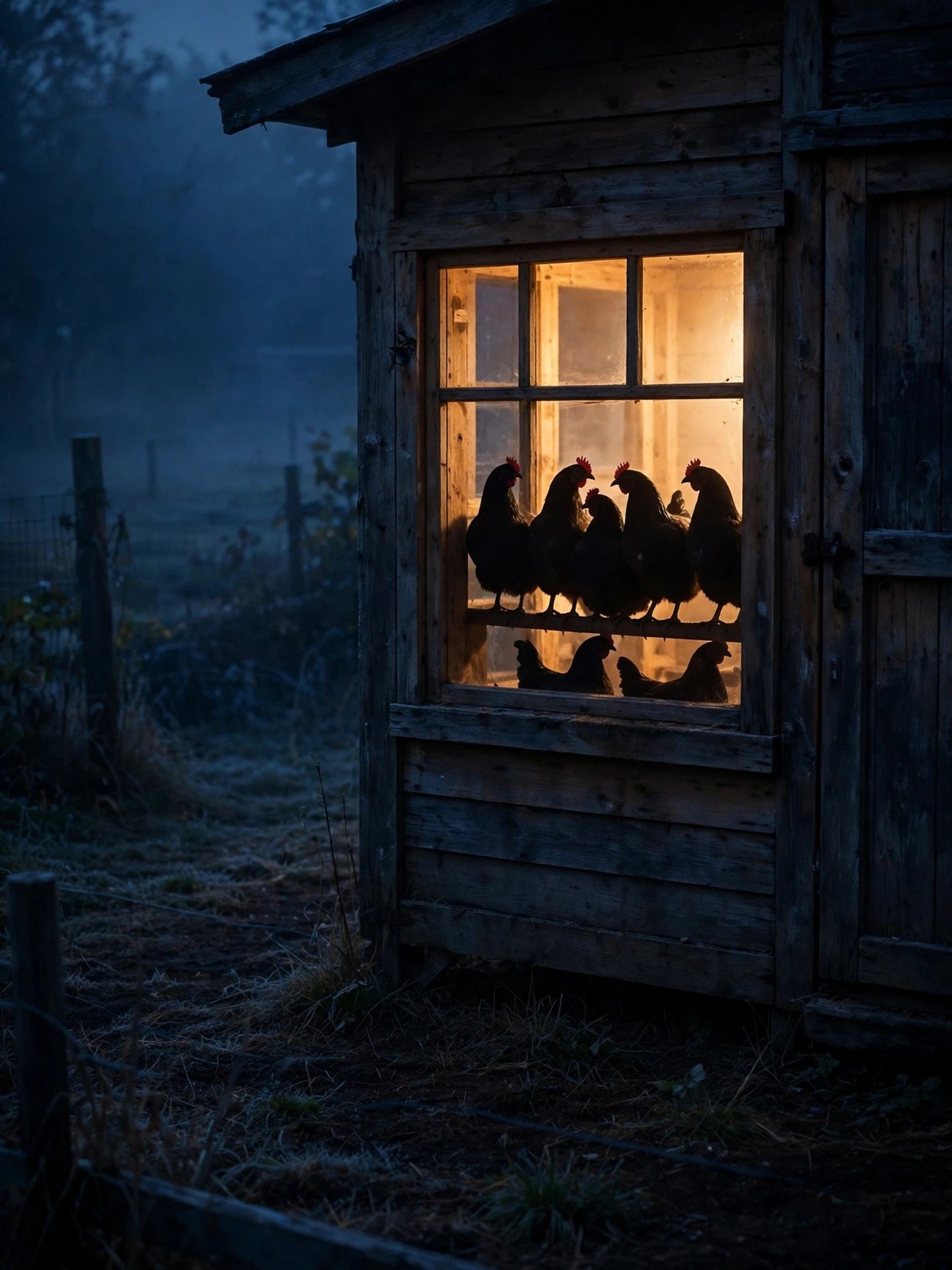
Why not add the hours in the evening instead, at a civilized time? Because of how hens go to bed. A hen roosts by fading light — she picks her spot, settles, and lets the dark come down around her. A lamp that clicks off at 8 pm does not fade. It drops the coop from full light to pitch black in a second, and any hen caught on the floor cannot see her way up to the roost. She sleeps on the floor, in the droppings, stressed — and a few birds caught mid-squabble can pile up badly. Morning light has no such trap. A lamp switching on early simply starts the day, and the day still ends the way hens are built for: slowly, at dusk.
One last piece of discipline: build up gradually. If your flock is on 10 natural hours today, do not jump them to 14 tomorrow. Add 15 to 30 minutes a week until you reach your target, keep the times identical every single day — the pituitary responds to a pattern, not an average — and allow two to three weeks before you judge the result. Hens who are going to respond to light do it on their own schedule, and an erratic lamp switched on whenever somebody remembers will convince nobody, feathered or otherwise.
What Kind of Light Do Hens Actually Need?
Warm, white and ordinary. The light that switches laying on is the light that resembles daylight, so a standard warm white household LED bulb is the whole answer — the same bulb you would put in a hallway. For brightness, forget the technical units and use the old keeper’s test that extension guides still repeat: bright enough to read a newspaper at floor level, where the hens are. In shop terms, a common 800 lumen LED bulb does that easily in a backyard-sized coop. You are recreating dawn, not floodlighting a yard. A dim bulb in the corner that barely reaches the roosts is worse than useless — the hens’ day is measured at the hen, not at the fixture.
LED earns its place three times over. It runs cool, which matters in a dusty wooden box full of dry bedding. It costs next to nothing to run, which matters when it burns four or five extra hours a day for four months. And it lasts for seasons, which matters because the one keeper guaranteed to forget to replace a dead bulb in November is every keeper. Whatever bulb you choose, buy one that is shatterproof or plastic-coated. Coops are active places, bulbs get knocked by flying hens and swinging feed bags, and a fragile glass bulb breaking into bedding that hens scratch and peck through all day is a genuine injury waiting to happen. A coated LED or a covered fixture removes that risk entirely.
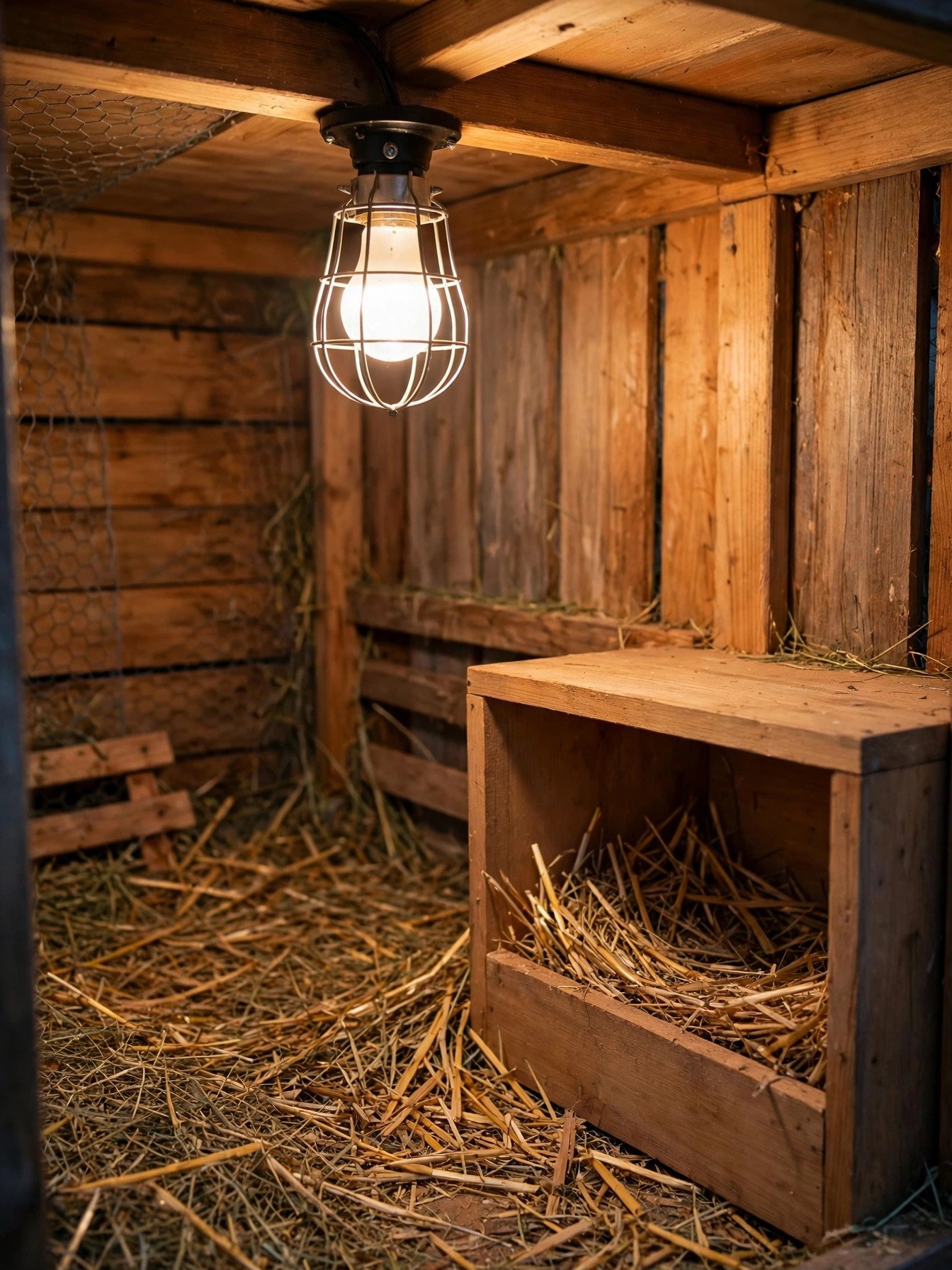
Now the red light myth, because it fills whole forum threads. Red bulbs are sold for chickens because of the brooder heat lamp tradition, and red light has real uses — it can calm birds and hide pecking injuries. But a red bulb does not count toward your 14 hours. The laying response is driven by bright, broad-spectrum light reaching the hen’s eye at proper intensity, and a dim red glow does not deliver it. If the only “coop light” in your setup is red, your hens are, as far as their laying cycle is concerned, still living on natural winter daylight — which is the exact problem you were trying to solve. Keep red lamps for chick heat. Laying light should look like morning.
One product worth clearing up while we are here: Omlet sells a small Coop Light that plugs into its Autodoor, and it is a genuinely handy thing — but it is a 1.5 watt LED that glows for a few minutes before the door closes at night, designed to call stragglers in off the run before bedtime. That is a bedtime beacon: brief, dim and in the evening, which is the opposite of a laying light in every respect. Different tool, different job.
Setting It Up Safely
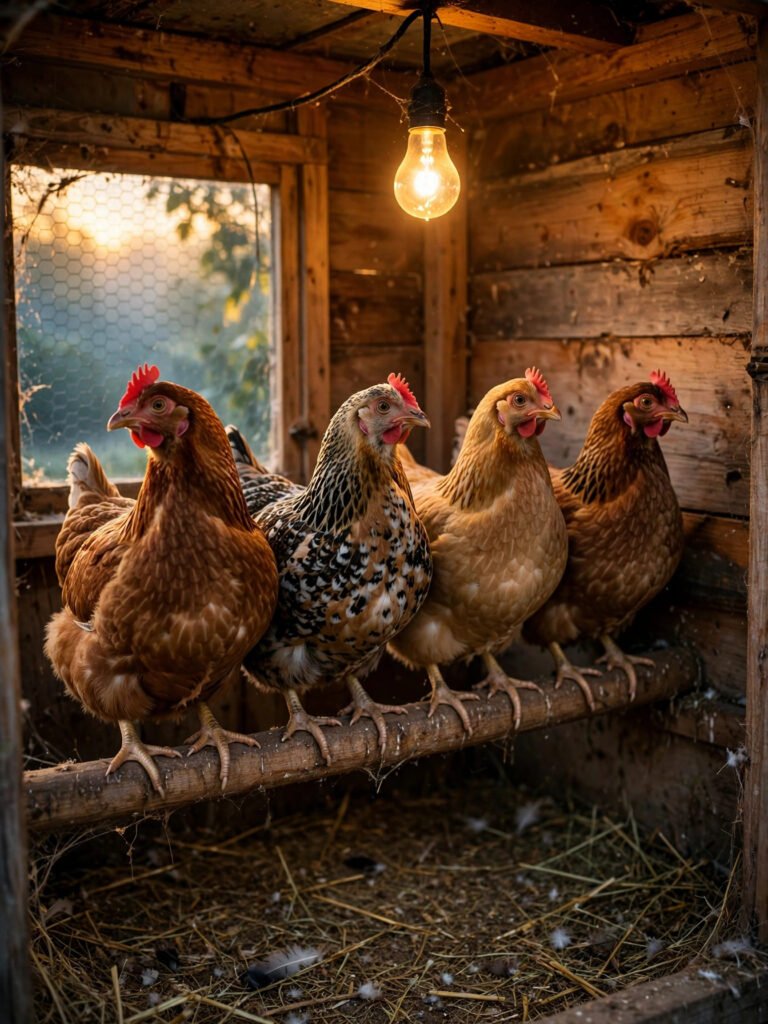
The light itself is trivial. The safety is the actual project, because a coop is a dusty, flammable, bird-occupied shed and electricity deserves respect in it. Start with the fixture: a proper lamp holder or enclosed fixture, screwed to the wall or ceiling where you decided it goes — never a clamp lamp dangling by its cord, never a bare bulb hanging at a height where a hen flying up to the roost can hit it. Run every cord flat along a wall, secured with clips or staples, well out of reach of beaks. Hens investigate cords the way toddlers investigate everything, and a pulled cord can bring the whole fixture down into dry bedding.
Then the timer, because the entire system stands or falls on it. The one feature that matters beyond basic programming is a built-in backup battery. Cheap timers without one forget everything in a power cut and come back on at whatever hour they please — and a light blazing at midnight or dark at 3 am is worse than no light at all, because the flock’s whole pattern is scrambled. A timer with battery backup rides through the outage and the hens never notice. This is the type we point keepers to:

- Up to 8 on/off programs on a 7 day schedule — set the morning light once, then step the start time earlier in one-minute increments as the days shrink
- Two grounded outlets, each controlled independently — the coop light on one, a second small lamp on the other if your coop needs the spread
- Built-in backup battery holds the clock and the program through a power cut, so one outage does not scramble the flock’s whole routine
Two honest notes on that timer: it is an indoor-rated unit, so it lives inside the coop where it stays dry — not out on the run fence in the weather — and the light load of a single LED bulb is far inside what it is built to switch. Last, the chore nobody mentions: dust. Coop dust settles on everything, it dims your bulb week by week, and dust caked onto a hot fixture is a fire risk. An LED running cool shrinks that risk, but the habit matters more than the hardware — wipe the bulb and fixture down whenever you do your regular coop clean, and glance at the whole setup, cords included, once a month, the same way you check latches.
The Honest Downsides of Lighting the Coop
Here is the case against, made as fairly as I can make it. You will read that every hen is born with a fixed number of eggs and that lights simply spend them early. The truth is softer than that — a hen carries far more ova than she will ever lay, so she is not working through a fixed wallet of eggs. The real cost is wear. Laying is hard, calcium-hungry work for a hen’s body, and a bird who lays straight through every winter gets no seasonal recovery. Keepers who light year after year commonly find their hens fade earlier in their later years — laying fewer, less reliable eggs in year three and four than a rested hen of the same breed. It is a pattern, not a laboratory verdict, but it shows up too often to wave away. If you want the full picture of a hen’s laying life, our guide to how long chickens lay eggs lays out the year-by-year expectations.
Then there is the molt collision. Most hens molt in autumn — the same weeks you would be starting the lights — and growing a full new set of feathers is the second most expensive thing a hen’s body does. Lighting a molting hen asks her to fund feather production and egg production at once, and she will short-change one of them, usually the eggs, sometimes her own condition. The sensible sequence most lighting keepers settle on is: let the molt finish in autumn’s natural short days, then bring the lights in once the feathers are back.
And underneath it all sits the simplest argument of all: the winter break is not a malfunction. It is the rhythm the bird was built on, and the one wild and heritage flocks have always kept. Commercial laying operations light their barns because their hens are replaced young, before the trade-offs ever come due. A backyard keeper who intends to keep the same hens for five or six years is running a different flock with different economics — and in that flock, resting the hens through the dark months and letting spring do the work is not laziness. It is a legitimate strategy with a long track record. My honest summary: lights are the right call if winter eggs genuinely matter to you and your flock is young. They are the wrong call if you are lighting out of guilt, for hens you hope to keep laying for years.
Frequently Asked Questions
How many hours of light do hens need to lay in winter?
Fourteen to sixteen hours of total light per day — daylight and lamplight combined. Fourteen is enough for most backyard flocks, sixteen is the ceiling, and hens still need roughly 8 hours of real darkness. Count backward from natural dusk to find your timer’s start time.
Why do you add the extra light in the morning instead of the evening?
Because hens roost by fading light. A lamp that clicks off in the evening drops the coop from full brightness to pitch black instantly, leaving birds on the floor unable to find the roost. Morning light simply starts the day early, and the day still ends with a natural, gradual dusk that lets every hen settle in order.
What kind of bulb should I use for a coop light?
A warm white LED bulb, bright enough to read a newspaper by at floor level — a standard 800 lumen household bulb is plenty for most coops. Choose a shatterproof or plastic-coated one so a knocked bulb cannot scatter glass into the bedding. Red bulbs do not count toward the light hours; they are a heat and calming tool, not a laying light.
Is it better to just let my hens rest over winter?
It is a fair choice, and plenty of good keepers make it. Rest mirrors the hen’s natural cycle and may keep her laying better in her later years; lights give you winter eggs now, possibly at the cost of some production down the line. Neither answer is wrong — it depends on whether you need winter eggs and how long you plan to keep the flock.
The Bottom Line
If you want eggs through winter, the whole system fits in one sentence: a warm white, shatterproof LED bulb in a fixed fixture, on a timer with battery backup, switching on at whatever early hour makes 14 hours by natural dusk, built up gradually and kept ruthlessly consistent. That is it. No special chicken bulb, no red glow, no evening hours. Done that way, coop lights for winter laying do exactly what the extension guides promise.
And if you skip the lights entirely, you are not doing winter wrong — you are choosing the rest your hens were built for, and spring will repay the patience. Either way, the winter evening is when a flock is most vulnerable, so pair your lighting decision with the other half of the routine: a door that shuts every hen in safely, on time, whether you are home or not. Our guide to the best automatic chicken coop doors covers the picks we trust for exactly that job.