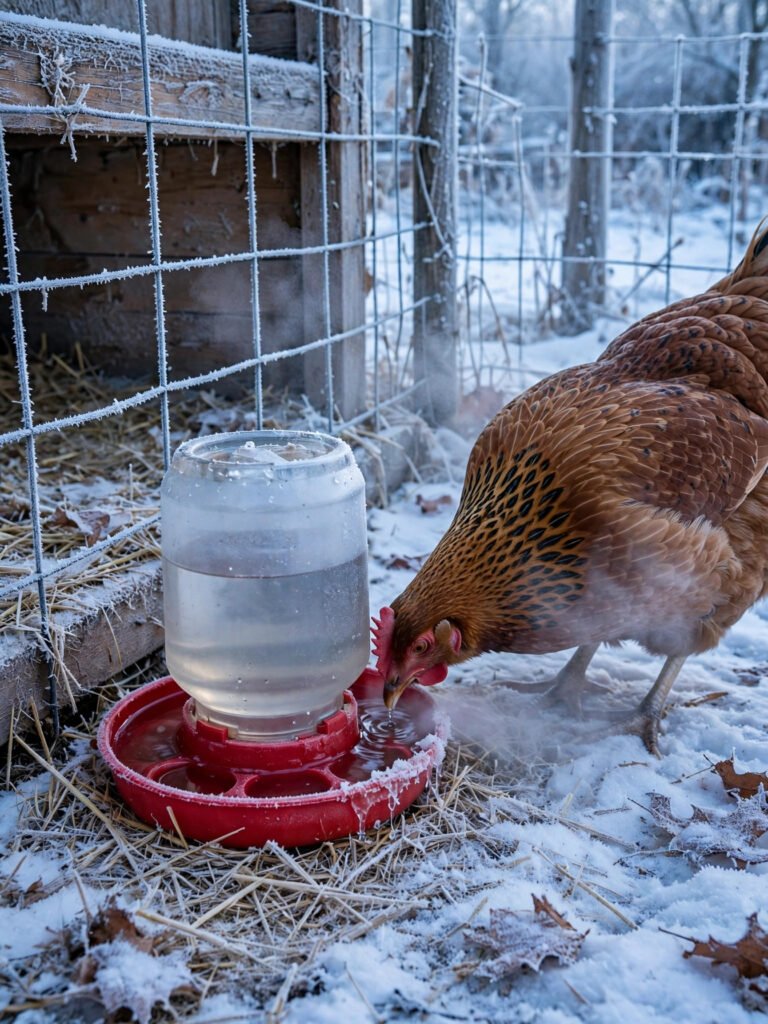

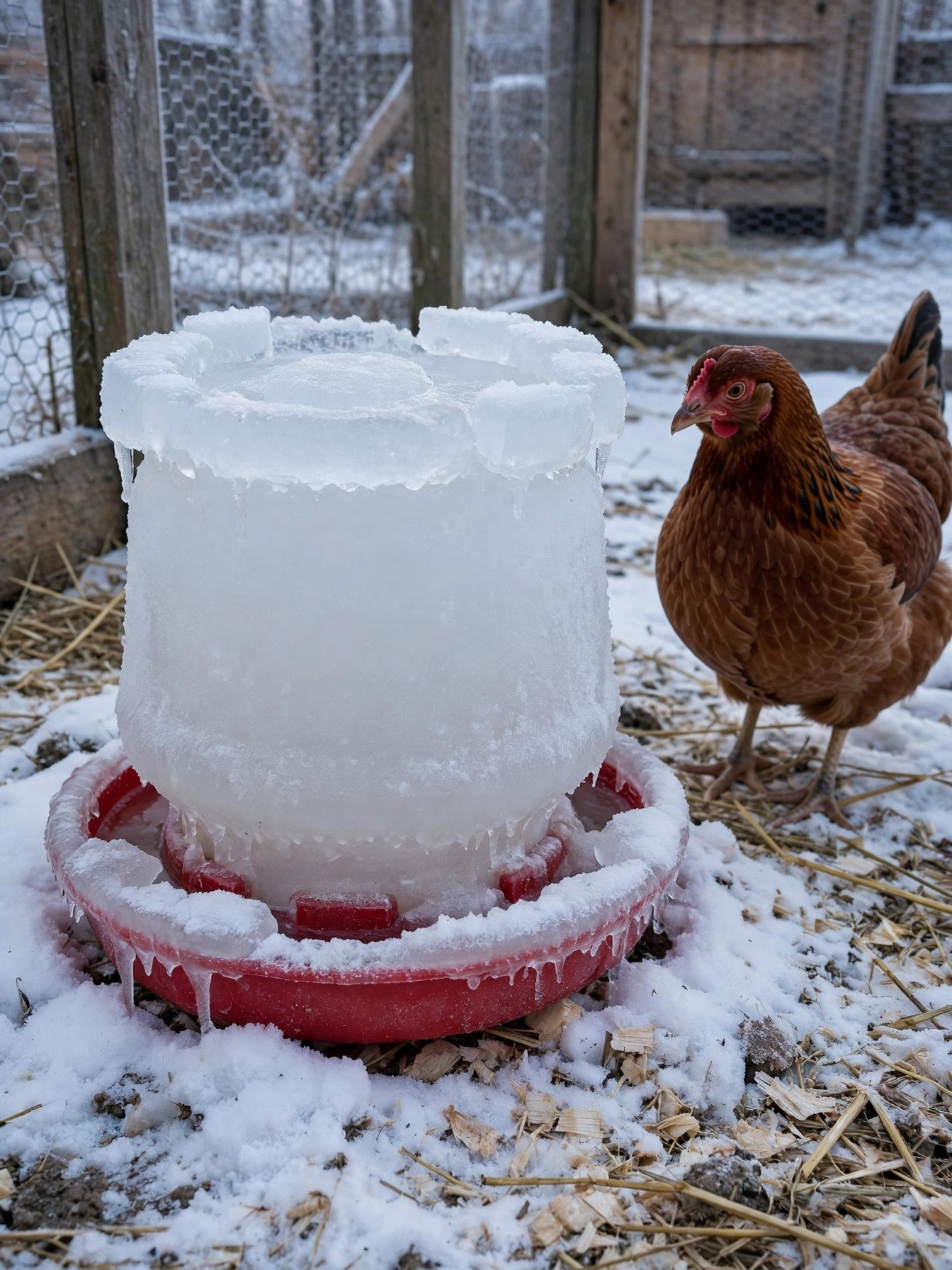
A frozen waterer is never just a frozen waterer. A hen drinks roughly twice as much water as she eats feed by weight — the numbers are in our guide to how much chickens eat and drink a day — and when the water turns to ice, her appetite goes with it. A thirsty hen eats less, a hen that eats less lays less, and within a day or two the egg basket shows it. Dehydration in winter is quiet, fast and completely avoidable, which is why a heated waterer is the one piece of electric gear I tell cold-climate keepers to buy before anything else.
Honesty rules before the picks, same as every guide on this site: we have not frozen these four waterers side by side in our own yard, and we are not going to pretend otherwise. Each pick was chosen from manufacturer specs — capacity, watts, thermostat behavior and the cold rating the maker actually publishes — cross-checked against the patterns that repeat in verified owner reviews. Where a brand’s cold claim looks optimistic next to what owners report, that gets said out loud below, including in the section on why hens stop laying eggs, where frozen water earns its own mention as a cause.
Quick Picks: The Short Version
| Waterer | Capacity | Watts | Style | Best for |
|---|---|---|---|---|
| Premier 1 All-Season Heated Waterer | 3 gallon | 100W | Integrated heater | The coldest winters on this list |
| Farm Innovators HPF-100 All-Seasons | 3 gallon | 100W | Integrated heater | Most flocks, most winters |
| Farm Innovators HP-125 Heated Base | Base only — sits under your metal fount | 125W | Heated base | Keepers who already own a metal waterer |
| RentACoop Zero Chill | 64 oz (half gallon) | 40W | Integrated heater + insulated cover | Small flocks and tiny coops |
1. Premier 1 All-Season Heated Waterer — Coldest-Rated Pick
Premier 1 is a fencing and livestock company first, and it shows in how this waterer is specified. The 3 gallon tank hides its heater inside the base, a built-in thermostat switches the element on when the air drops below 40°F and off again at 60°F, and Premier rates the unit to keep water flowing down to -20°F — the strongest cold claim in this guide, printed by a company that sells to working farms and tends not to bluff. The quick-fill lid is the daily-life detail owners praise most: you top it up from above with a jug instead of flipping a full, sloshing fountain upside down.

- Internal 100W heater with a built-in thermostat — on below 40°F, off at 60°F, so it only draws power when the cold actually threatens
- Premier rates it to keep water flowing in temperatures as low as -20°F, the deepest cold rating of any pick here
- Quick-fill lid for topping up from the top, and it can hang above the bedding to stay cleaner
What we like:
- The thermostat band is published, not vague. On at 40°F, off at 60°F — you know exactly when it is spending your electricity, and it is not cooking the water in a mild snap
- The -20°F rating comes with a farm supplier’s reputation behind it, and owner reports from genuinely cold states line up with it better than most brands’ claims do
- Top filling. Anyone who has wrestled a frozen 3 gallon fountain apart at dawn in January will understand why this alone sells the unit
What holds it back:
- Premier’s own manual places it inside a coop or shed, sheltered from snow and rain. That -20°F figure assumes a sensible, sheltered setup — park it in an open windy run and you are testing a claim nobody made
- It is the premium-priced end of this list, and the replacement lids and parts mostly come through Premier rather than any farm store shelf
- Like every open-trough fountain, the drinking tray still collects bedding and needs a rinse most days
Not for: keepers in mild-winter states who freeze a handful of nights a year — you are paying for capacity you will never use. For: northern flocks, unheated coops, and anyone whose January makes the other ratings on this page look nervous.
2. Farm Innovators HPF-100 — Best for Most Flocks
If the Premier is the specialist, this is the waterer that has been quietly doing the job in thousands of coops since the late 2000s. The HPF-100 is a 3 gallon plastic fountain with the heater built into its red base, thermostatically controlled so it runs only when freezing threatens, and Farm Innovators rate it to keep water liquid down to about 0°F. It fills from the bottom, can sit on the floor or hang, and uses the same familiar fountain shape your hens already know — no retraining, no nipples for an older flock to figure out in the cold.

- Heater built into the base of the fountain itself — one unit, nothing extra to buy or stack
- Thermostatically controlled 100W element; Farm Innovators rate it to keep water from freezing down to about 0°F
- Fills from the bottom, hangs or stands, and works as the flock’s ordinary fountain the rest of the year
What we like:
- The track record. This model has been sold for well over a decade, which means the failure stories are known, rare for the category, and mostly about cords rather than heaters
- Zero learning curve for the hens. It drinks like the summer fountain it replaces, which matters more than any spec when the flock is already stressed by cold
- Year-round use. Unplugged, it is simply a 3 gallon fountain — the heater is only there when winter is
What holds it back:
- About 0°F is the honest floor of its rating. In a hard continental cold snap, owners report skim ice forming in the trough on the worst nights even while the reservoir stays liquid — the Premier above is the pick for that weather
- Bottom filling a 3 gallon fountain means lifting and flipping close to 25 pounds of water, and doing it without spilling takes practice
- The drinking trough sits low, so on the floor it collects shavings. Hang it or raise it on blocks
Not for: anyone whose winters regularly push below 0°F, or anyone who cannot lift a full fountain. For: the typical backyard flock in a typical cold state — which is most of the people reading this page.
3. Farm Innovators HP-125 — Best Heated Base
The base takes the opposite approach to everything above: instead of a new waterer, you keep the double-wall galvanized metal fount you already own and stand it on a heated disc. The HP-125 puts out 125 watts through a thermostatically controlled element, Farm Innovators rate it to keep water from freezing in temperatures as low as 10°F, and a bottom cover keeps straw and debris away from the heating element. It is the cheapest route into heated water on this page — as long as the fount in your coop is metal, because that condition is not negotiable.

- Heats the metal fount you already own — no new waterer for the hens to learn
- 125W thermostatically controlled element; rated to keep water from freezing down to about 10°F
- Bottom cover shields the heating element from straw and coop debris; made for double-wall metal founts only
What we like:
- It respects the gear you already bought. A good galvanized fount lasts for years; this keeps it in service all winter instead of replacing it with plastic
- Heat from below is the efficient direction. Warmth rises through the water column, and the metal fount spreads it evenly — the trough edge is the last place to skin over
- Nothing for hens to damage. The works sit underneath the fount, out of beak range, in a covered housing
What holds it back:
- Metal founts only, full stop. Setting a plastic waterer on a heated base is exactly the mistake the safety section below warns about — plastic softens, warps and can fail against a hot plate it was never designed for
- Its 10°F rating is the mildest of the four picks. Fine for most winters, not the tool for a Minnesota January
- Farm Innovators specify a dry, covered spot. A base sitting in spilled water and mud is a base being used against its instructions
Not for: plastic waterer owners — and please do not improvise around that — or the coldest climates. For: anyone with a sound galvanized fount and winters that bottom out in the teens.
4. RentACoop Zero Chill — Best for Small Flocks
Not every flock needs 3 heated gallons. The Zero Chill is a 64 ounce nipple drinker — half a gallon, one horizontal nipple, a cone lid that stops hens roosting and fouling the top — wrapped in an insulated cover with a small 40 watt heater inside. RentACoop say it was cold-tested to -10°F, and the insulation is doing real work in that claim: a small, wrapped reservoir loses heat far slower than a big open one. For two to four hens in a small coop, it is the right-sized answer, and nipple water stays clean in a way trough water never will.

- Low-wattage 40W heater with automatic on and off, wrapped in an insulated cover — RentACoop rate it for cold down to -10°F
- Horizontal nipple keeps the water sealed and clean, and the cone lid stops hens perching and fouling the top
- BPA-free ABS body sized for small flocks, quail and compact coops where a 3 gallon fountain simply does not fit
What we like:
- Clean water, always. A sealed nipple drinker cannot be scratched full of bedding, and in winter that also means no slush of shavings and ice to chip out
- The running cost is tiny. At 40 watts, thermostatically switched, it sips electricity next to the 100-plus watt fountains — and if you are budgeting winter feed and power together, our Chicken Feed Calculator covers the feed half of that math
- It fits where nothing else here does — small coops, quarantine pens, a broody hen’s corner
What holds it back:
- Half a gallon is half a gallon. Four hens can work through it quickly, so expect near-daily refills — this is a small-flock tool and does not pretend otherwise
- Some owners in hard cold snaps report the exposed nipple cup icing up even while the reservoir behind it stays liquid. The tank is heated and insulated; the little metal nipple tip is the exposed weak point of every nipple design
- Hens raised on open water need to learn the nipple, and the week you teach it should not be the coldest week of the year
Not for: flocks bigger than about four birds, or keepers who travel in winter and need days of capacity. For: the two-to-four-hen coop, bantams and quail, and anyone whose winter water problem is cleanliness as much as ice.
Heated Base vs All-in-One: The Honest Trade-Offs
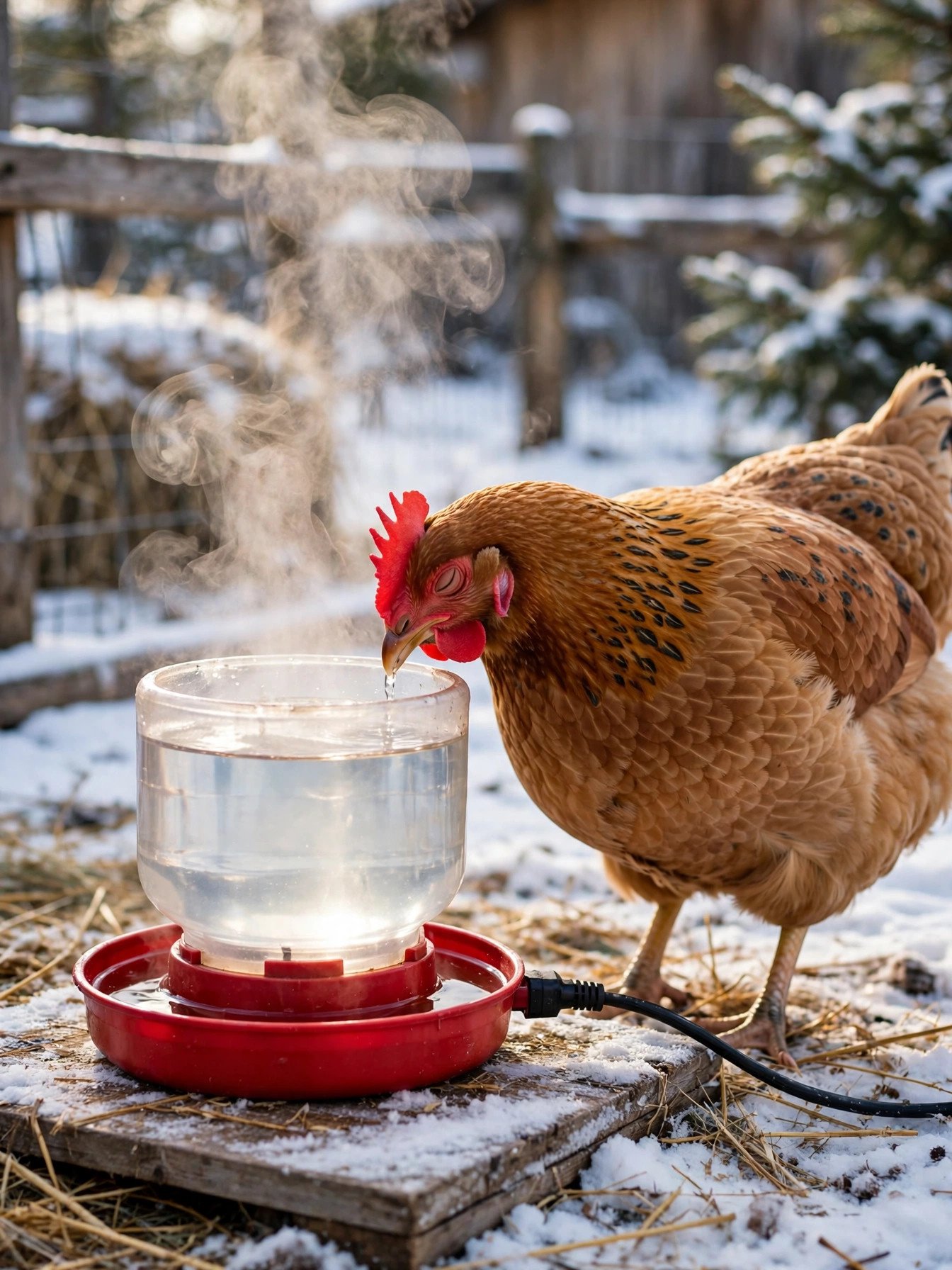
Strip away the brands and there are really two machines here. An all-in-one — the Premier, the Farm Innovators fountain, the little RentACoop — arrives as one sealed unit: heater, thermostat and reservoir designed together, one cord, nothing to match or stack. That integration is its own safety feature, because the manufacturer has already answered the question of whether this plastic belongs next to this heating element. The price of it is that when the heater eventually dies, the waterer usually goes with it.
A heated base splits the job in two. Your metal fount keeps doing the water part for as many years as galvanized steel lasts, and the base underneath is a simpler, cheaper thing to replace when it gives up. You keep the waterer your flock knows and your wallet already paid for. What you take on in exchange is the matching: the base only works under metal, its cold rating is usually milder, and the whole stack is only as weatherproof as the spot you put it in. Neither design is the grown-up choice and neither is the cheap shortcut. They suit different coops — the base suits a coop that already owns a good fount, the all-in-one suits a coop starting from nothing.
The Safety Checklist
Electricity, water and bedding share a small wooden box all winter, so this part matters more than any pick above it. Four rules cover almost everything that goes wrong:
- Thermostat-controlled, always. Every pick in this guide switches itself on near freezing and off above it. A heater that runs flat-out around the clock wastes power, warms water enough to grow things in it, and has no business in a coop. If a listing does not say thermostatically controlled, do not buy it
- Protect the cord. Hens peck at cords, rodents chew them, and a damaged cord in damp bedding is the real fire risk in a winter coop — not the heater itself. Route cords up and out of reach, cover exposed runs, and inspect them every time you clean
- Never heat a waterer that is not rated for it. Do not stand an ordinary plastic fount on a heated base, and do not drop a de-icer into a container the maker never approved for one. The all-in-one plastic fountains above are engineered for their built-in elements — that is a different thing entirely from improvising heat under thin plastic
- Plug into a GFCI outlet. Ground-fault protection is the cheap device that cuts power the instant current leaks where it should not — toward water, for instance. If the coop circuit does not have it, a GFCI adapter on the outlet is a small purchase that closes the biggest safety gap in the whole setup
How Cold Are We Talking?
Here are the four cold claims in one place, stated the way they should always be stated: as manufacturer ratings, not as things we measured. Premier rates its waterer to keep water flowing at -20°F. RentACoop describe the Zero Chill as cold-tested to -10°F. Farm Innovators rate the HPF-100 fountain at about 0°F and the HP-125 base at about 10°F. Those numbers are the brands’ own, and we have flagged them that way in every section rather than laundering them into our own testing claims.
Two honest footnotes apply to all four. First, every rating assumes a sheltered placement — inside a coop or under cover, out of the wind. Wind chill strips heat from an exposed waterer far faster than still air at the same temperature, and no rating on any box accounts for your run. Second, owner reports follow a pattern worth knowing: units generally hold their ratings in sheltered coops, and the first thing to ice in a hard snap is the exposed drinking edge — the fountain trough, the nipple tip — while the reservoir behind it stays liquid. Plan for the rating to be roughly true, site the waterer like the number depends on it, because it does, and check the drinking edge on the coldest mornings whatever you bought.
Frequently Asked Questions
How many watts does a heated chicken waterer use?
The four picks here run from 40 watts for the little RentACoop up to 125 watts for the heated base, with the two 3 gallon fountains at 100 watts each. All four are thermostatically controlled, so they only draw that power when the temperature is near freezing — on a mild winter day the true consumption is a fraction of the nameplate number.
Can I put a heated base under a plastic waterer?
No. Heated bases like the HP-125 are made for double-wall metal founts only. Ordinary plastic was never designed to sit on a hot plate and can soften, warp or fail. If your waterer is plastic, the safe route is an all-in-one heated fountain whose element was built into it by the manufacturer.
Do hens drink less in winter?
Slightly less than in summer heat, but far more than most people guess — and the link between water and feed is direct: a hen that cannot drink will not eat properly, and laying falls off within days. That is why frozen water shows up as a cause in our guide to why chickens stop laying eggs. Treat winter water as a laying input, not a chore.
Where should a heated waterer sit — inside the coop or in the run?
Inside, or at least under solid cover, is the setup every rating in this guide assumes. A sheltered waterer holds its freeze protection far better, the cord stays drier, and the hens drink where they are already spending the coldest hours. If you are still at the planning stage, our guide to backyard chickens for beginners covers where water belongs in the whole setup.
The Bottom Line
Forced to hand one waterer to one keeper, it is the Farm Innovators HPF-100 — 3 gallons, a thermostat that minds itself, a 0°F rating that covers most winters, and a decade of coops quietly proving it. If your winters are the serious kind, step up to the Premier and its -20°F rating and be done with the question. If a good galvanized fount already stands in your coop, the HP-125 base is the cheapest honest fix on the page. And if your flock is four hens in a small coop, the little RentACoop is the one sized like your life actually is.
Whichever you choose, decide before the first hard freeze, not during it — heated waterers sell out in the first cold snap of every year, and chipping ice at dawn while the shops restock is a rite of passage you are allowed to skip. Set it up on a GFCI outlet, protect the cord, and let the thermostat do the worrying from there.