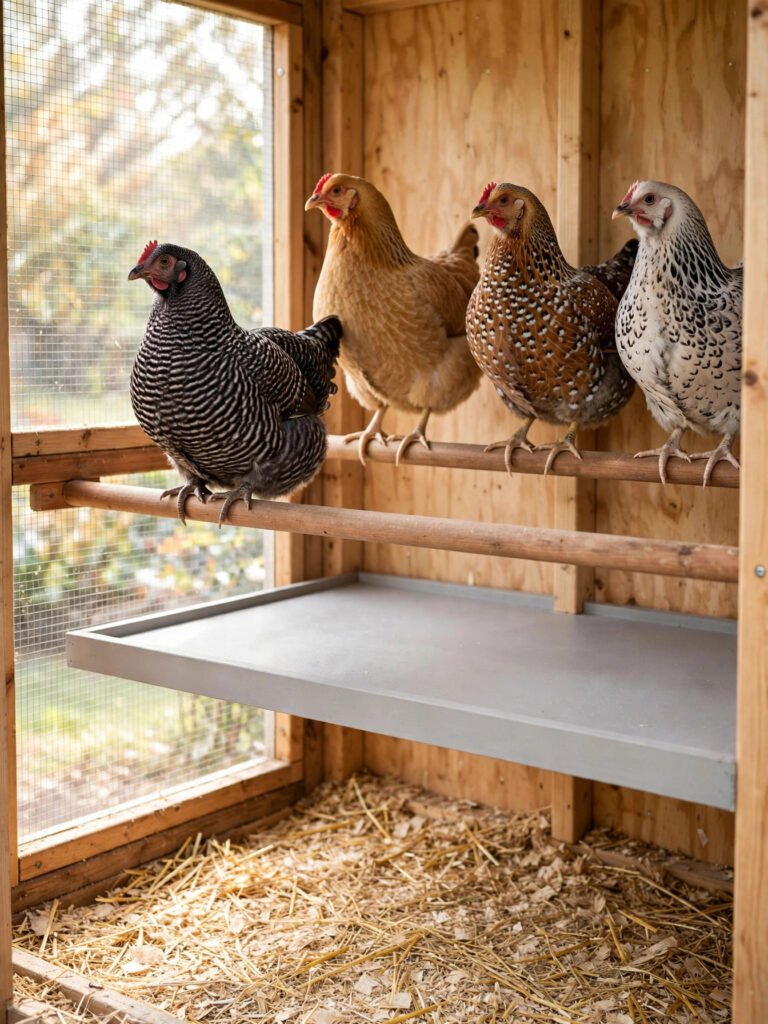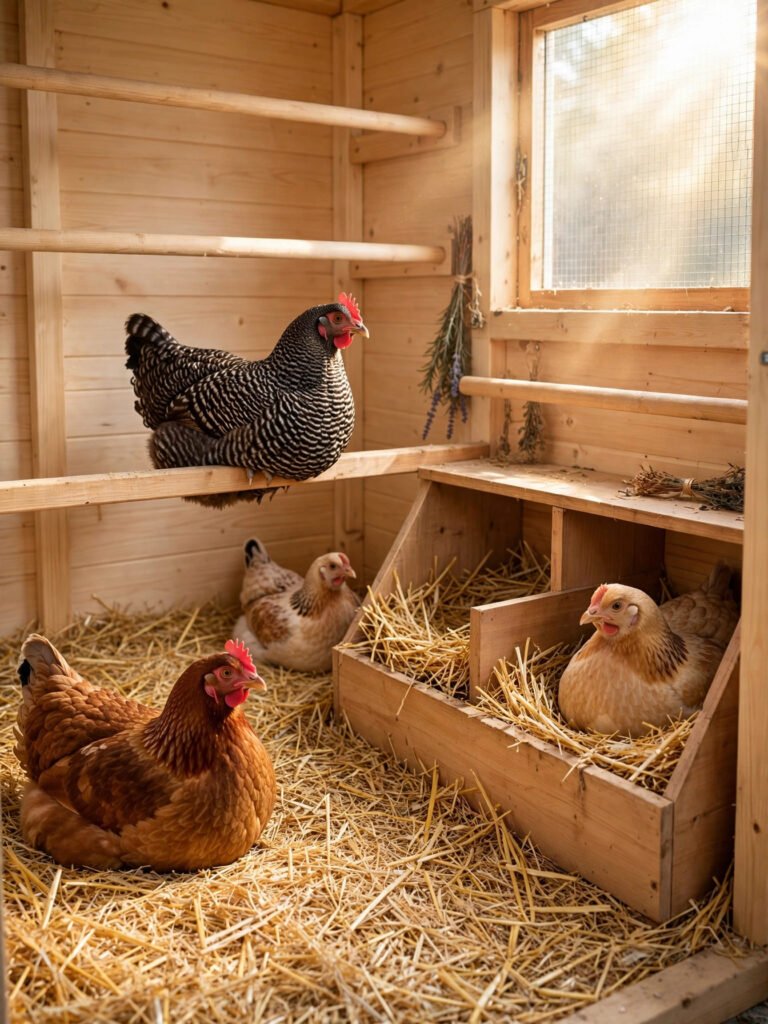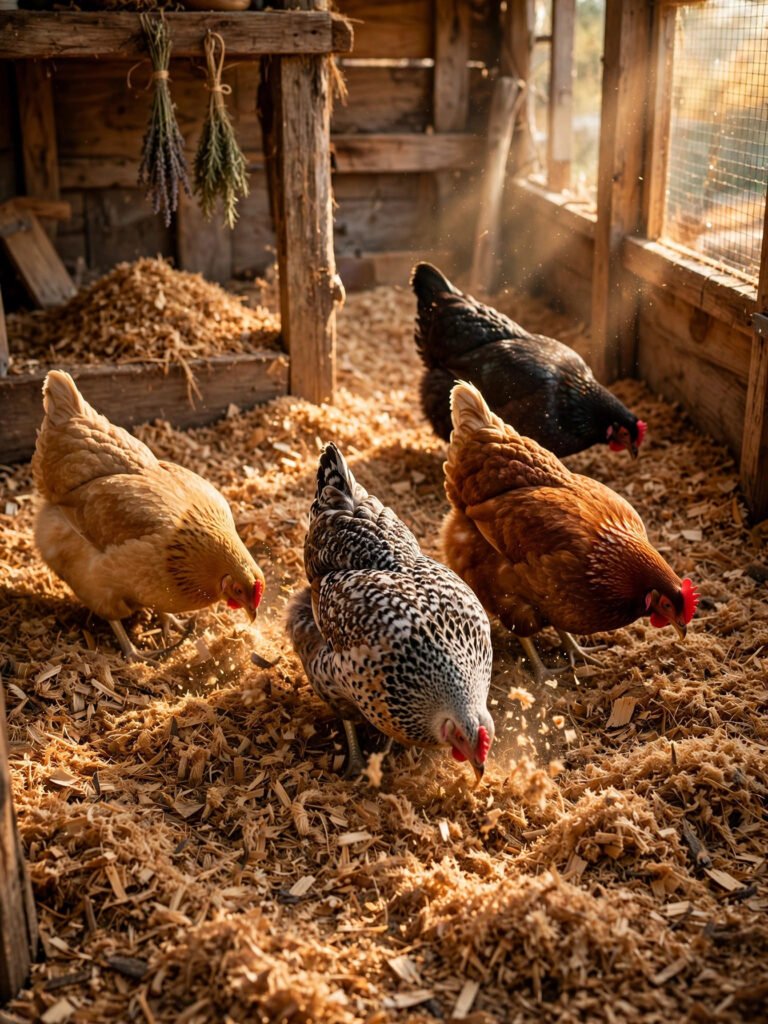
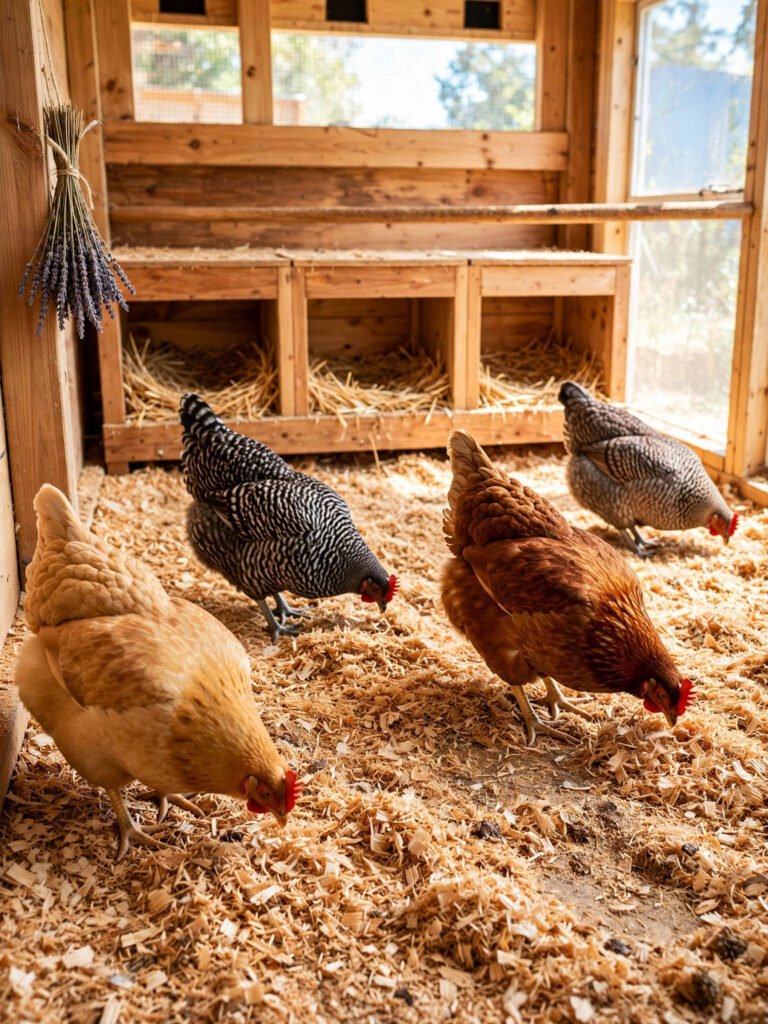

Short answer first: for most backyard coops, the best chicken coop bedding is large-flake pine shavings — cheap to replace, properly absorbent, light to handle and compostable when it is done. The honest one-liners for the other two: straw is the coziest and easiest to find, but soaks up the least and needs changing the most. Sand gives you the cleanest daily routine if you scoop it like a litter box — and the heaviest, least forgiving setup if you get the wrong type or stop scooping. Everything below is those three sentences, proven out.
One thing before the table: bedding reviews are full of keepers swearing by a material that failed completely for somebody else. Both are usually telling the truth. Bedding is not good or bad on its own — it is good or bad for a cleaning routine. So this guide compares the three the way you will actually live with them: how much they absorb, how they handle smell, how often you will be changing or scooping, and what you do with the stuff when it comes out. Nothing here was “tested” in a lab; the comparisons come from how these beddings behave in real coops and the patterns that show up again and again in keeper experience.
Pine vs Straw vs Sand at a Glance
| Bedding | Absorbency | Odor control | How often you change it | Compost? | Best for |
|---|---|---|---|---|---|
| Large-flake pine shavings | Good — flakes soak and hold moisture well | Good while dry and topped up | Spot clean weekly, full change every 4 to 6 weeks | Yes — a compost staple | Most coops, most keepers |
| Straw | Weakest of the three — sheds water more than it soaks it | Poor once damp; holds smell in the mat | Full change every 1 to 3 weeks, more in wet weather | Yes, but breaks down slowly | Winter warmth and nesting, dry climates |
| Sand (coarse, washed) | Does not absorb — droppings sit on top to be scooped | Excellent if scooped daily, dreadful if not | Scoop daily; top up a few times a year, full change rare | No — the sand itself goes nowhere | Daily scoopers with a solid, ground-level floor |
| Hemp | Best of the four — holds several times its weight | Best of the four — traps ammonia in the layer | Spot clean, full change every 6 to 10 weeks | Yes — breaks down fast | Smell-sensitive keepers and deep litter |
Pine Shavings: The Default for a Reason
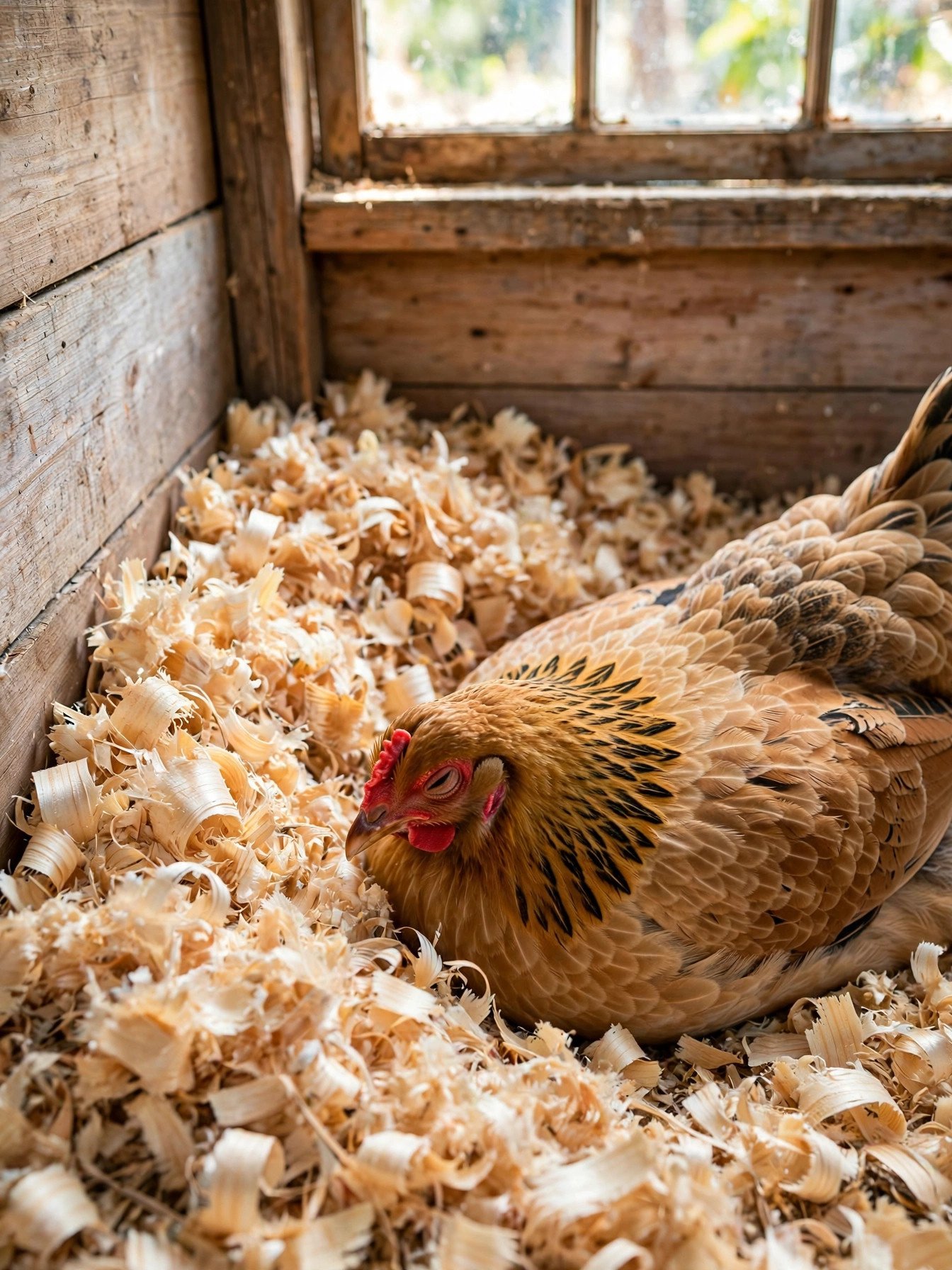
Pine shavings are what most coops run on, and after you have handled the alternatives it is easy to see why. A fluffed layer a few inches deep soaks up droppings and spilled water, keeps the floor dry to the touch, and turns cleaning into a fork-and-bucket job instead of a scraping job. The flakes are light — one compressed bale covers a whole coop floor — hens scratch through them happily, and spent bedding goes straight onto the compost pile. It is also the most forgiving bedding on this page: miss a week of spot cleaning and pine shrugs it off.
The details that matter are in the words “large flake.” Big flakes stay fluffy, absorb well and carry very little dust. The fine, powdery shavings sold for small pets are a different product with different problems, and they get their own warning further down this page. Buy kiln-dried, large-flake shavings in the biggest bale you can store — small bags are the expensive way to buy the exact same wood.

- 141 liter compressed bale (12 lb) that expands to more than 2.5 times its packed size once opened — one bag beds a standard coop floor
- 100% natural pine shavings, sustainably sourced from U.S. pine, with nothing added
- Made for the whole routine: coop floors, nesting boxes and chick brooders
What we like:
- It does every job adequately and most jobs well — absorbency, odor, insulation, composting, nesting boxes, brooders. No other material here can say that
- It is sold everywhere — farm stores, big box stores, delivered to your door. You will never be caught without bedding because one shop was out of stock
- It suits every management style: thin layer with weekly changes, or built up deep for deep litter
- The weight. A full bale is a one-arm carry, which matters more by your third winter than any other spec
What holds it back:
- Quality swings between brands and even between bales. A dusty bale happens, and you will be the one breathing it while you spread it
- Flakes blow around. In a windy run, pine migrates everywhere except where you put it
- It is a consumable forever — unlike sand, you will be buying and composting it for as long as you keep hens
Skip pine if: you genuinely enjoy a daily two-minute scoop and want a floor you never fully change — that is sand’s whole pitch, and it is a fair one.
Straw: Cozy, Cheap and High Maintenance
Straw has been bedding animals for centuries, and the hens vote for it every time — nothing gets scratched, kicked and rearranged with more enthusiasm, and a thick layer in the nesting boxes makes beautifully cushioned nests. It is also the warmest-feeling bedding here, which is why cold-climate keepers spread it thick in winter. If straw were absorbent, this guide would be one section long.
It is not absorbent, and that single fact drives everything else. Straw is hollow tubes. Water and droppings mostly slide off and pool underneath, where a matted top layer seals the damp in. From above, the coop can look fine while the layer below is wet and starting to smell — and damp straw is mold’s favorite address. The hollow stems can also shelter mites between changes. Straw asks for a full change every one to three weeks, sooner in wet weather, and it tangles around a fork like it is being paid to.
What we like:
- The hens love it — for scratching, dust-bathing in the dry stuff, and building nests they clearly consider architecture
- Warmth. A deep straw layer is genuine insulation over a cold floor in January
- Availability. Anywhere near farmland, straw is the easiest bedding in the world to get, season after season
What holds it back:
- The weakest absorbency of the three — it manages moisture by hiding it, and only for a while
- It mats. Once a straw layer mats, odor control goes with it, and the whole lot has to come out
- It composts slowly; those hollow stems take their time breaking down
Skip straw if: your climate is humid, your coop is small (damp and ammonia build faster in small air volumes), or you know in your heart the changes will slip. Straw punishes a relaxed schedule harder than anything else here.
Sand: The Litter Box Method
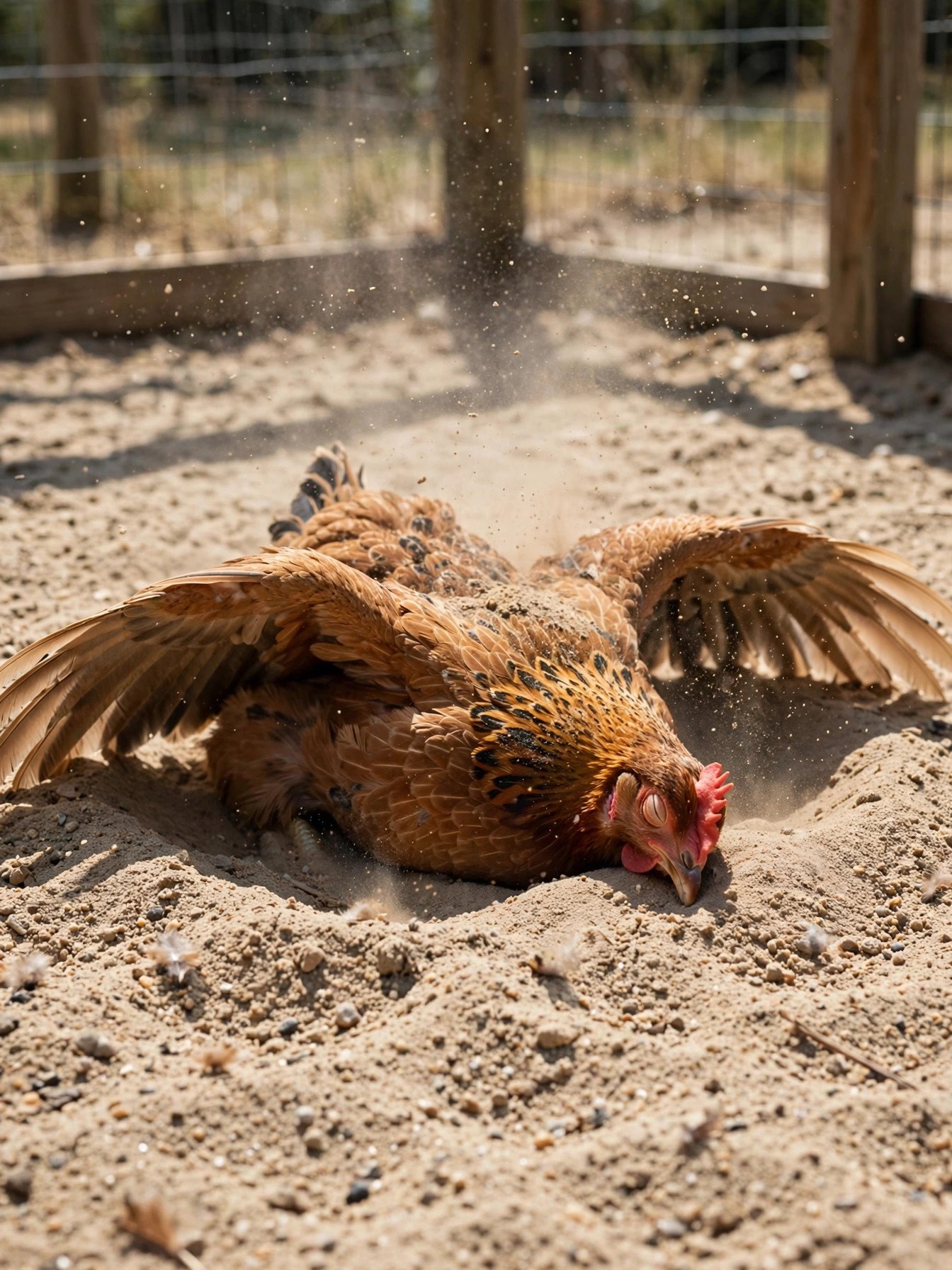
Sand works on a completely different principle, so judge it differently. It absorbs nothing. Droppings land on top, dry out fast on the surface, and you remove them with a scoop or a long-handled rake — two minutes a day, and the floor is genuinely clean in a way no absorbent bedding ever is. There is no rot, no mold, and almost no replacement cycle: you top up a little as the scoop carries sand away, and a full change is an event measured in years, not weeks. For the right keeper, it is the tidiest system on this page.
The conditions, though, are strict. Only coarse, washed construction sand belongs in a coop. Play sand and fine bagged sand are ground so smooth they pack, hold moisture and raise dust — and fine sand swallowed with feed is the kind linked to impacted crops. Coarse sand’s gritty, varied grains drain instead of packing. Second condition: weight. Sand is enormously heavy and belongs on a solid, ground-level floor — a raised wooden floor was never designed to hold several hundred pounds of it. Third: sand insulates nothing. In a cold climate the floor stays cold, and hens coming down off the roost feel it.
What we like:
- The daily routine is the fastest here — scoop, done, and the floor is clean rather than merely covered
- Nothing rots. No mold, no matting, no bedding turning into a science project if your week gets busy — wet spots are visible and scoopable, not hidden
- Barely any waste to dispose of. The scooped droppings compost beautifully; the sand stays in the coop
What holds it back:
- The installation. Hauling and spreading sand is the heaviest afternoon in chicken keeping, and removal — if you ever change your mind — is worse
- Skip the scooping for a week and sand’s advantage inverts: droppings get trampled in, and you own a dirty floor that cannot simply be changed out
- In a badly drained spot, sand becomes a wet, cold slab hens avoid and keepers curse
Skip sand if: your coop is raised, your winters are hard, or your cleaning style is “big session on the weekend” rather than “two minutes daily.” Sand rewards exactly one kind of keeper.
What About Hemp and Wood Pellets?
Hemp is the premium alternative, and the premium is real. Hemp absorbs more than pine by weight, holds that moisture down in the layer where it locks away ammonia instead of releasing it, and comes out of the bag with noticeably less dust than any wood product. Keepers who switch usually say the same two things: the coop smells better for longer, and full changes stretch out by weeks. It composts faster than pine too. The honest downsides are money and logistics — bag for bag it costs more than shavings, and most keepers have to have it shipped rather than grabbing it at the farm store on Saturday. If odor is your main battle, or anyone in the house is dust-sensitive, hemp is not a luxury. It is the fix.
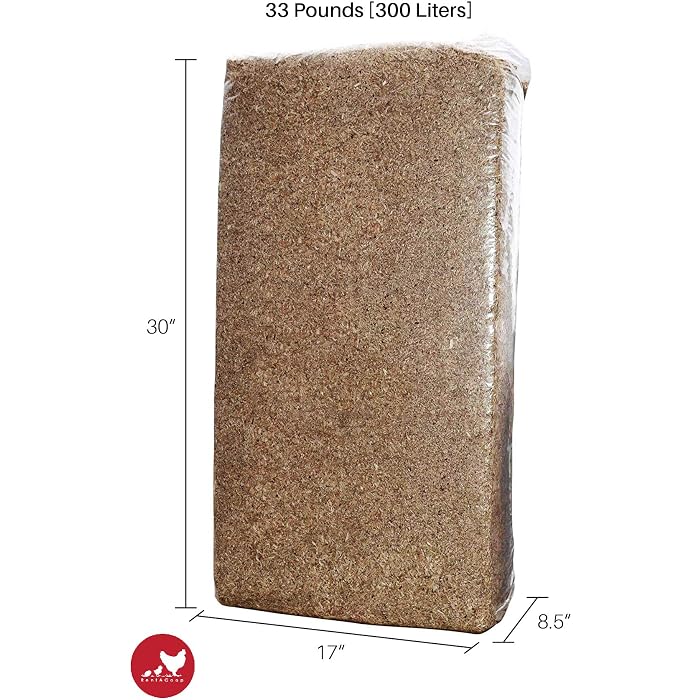
- 300 liter bale (30 lb) that expands to about 10.6 cubic feet — covers roughly 60 sq ft at a 2 inch depth, a full standard coop floor
- Extra-soft, rounded hemp fibers, 100% natural with no chemicals and no added fragrance
- Low-dust formulation, and fully biodegradable — spent bedding goes straight onto the compost pile
Wood pellets — the compressed stall pellets sold for horses — get an honorable mention. Dry, they are hard little cylinders hens cannot scratch through; add moisture and each pellet swells and collapses into absorbent fluff that locks liquid away impressively well. A pellet layer under the roosts, where the overnight droppings land, is a trick a lot of experienced keepers swear by. As a whole-coop bedding they break down into the fine material we warn about below, so we rate them a specialist tool: brilliant under roosts and in brooders, mixed with shavings, rather than a floor on their own.
The Ones to Avoid
- Cedar shavings. The strong smell that makes cedar appealing in a closet comes from aromatic oils that irritate bird respiratory systems — and a hen’s breathing is far more delicate than yours. Cedar is the one wood shaving with a genuine safety question over it, and there is no reason to risk it when pine exists.
- Fine, dusty sawdust. It coats everything, hangs in the air you and the hens breathe, packs into a mat when wet, and chicks can eat it thinking it is food. If a scoop of your bedding pours like flour, it is the wrong product. Sawdust from treated wood is worse still — never use it.
- Hay. Hay is feed, not bedding, and it behaves like feed: hens eat the seeds out of it, trample the rest into a dense mat, and that mat molds faster than straw ever does. Long swallowed strands are also a known crop-impaction risk. Bed chickens on straw if you want the farm look.
A Note on the Deep Litter Method
One method rearranges this whole comparison. With the deep litter method, you do not change bedding for months — you keep adding fresh material on top and let the bottom layer compost in place, microbes and all. Run that way, pine and hemp stop being a weekly chore with a running replacement cost and become a slow system you harvest once or twice a year as finished compost. Straw alone struggles as deep litter because it mats before it composts, and sand cannot deep litter at all — there is nothing in it to break down. If the change-frequency column above is the one deciding it for you, read the deep litter guide before you choose: it rewrites that column for two of the three materials.
Frequently Asked Questions
How deep should chicken coop bedding be?
For a regular change-it-out routine, 2 to 4 inches of pine shavings or hemp is the working depth — enough to absorb and let hens scratch, not so much you are throwing clean bedding away at every change. Straw wants 4 to 6 inches because it compresses fast. Sand goes in at 3 to 4 inches. Deep litter is its own system: start around 4 inches and build toward 8 to 12 over the season.
Can I mix different beddings in one coop?
Yes, and plenty of keepers do it deliberately: wood pellets under the roosts where droppings concentrate, shavings everywhere else; a straw layer over shavings for winter warmth; hemp in the nesting boxes of a pine-bedded coop because it stays cleaner around eggs. The one mix that makes no sense is sand with anything absorbent — the systems work opposite ways, and you end up scooping your shavings out with the droppings.
What is the best bedding for winter?
Deep pine shavings or hemp, because bedding is floor insulation as much as flooring — a thick, dry layer between hens and a cold slab is real warmth, and the deep litter version quietly generates a little heat of its own as it composts. Straw over shavings is a decent budget version of the same idea. Sand is the winter loser: it holds no warmth at all. Whatever you bed with, space matters more — a coop sized by the space rules stays drier and fresher in winter than a crowded one on any bedding.
Are pine shavings safe for chickens?
Yes — kiln-dried pine shavings are the standard coop bedding and have been used safely for generations of flocks. The wood to worry about is cedar, not pine. Two genuine cautions: choose large-flake over fine, dusty shavings, and avoid any bag that smells of chemicals or comes from treated wood. Raising chicks? Put them on large flakes or hemp from the start — tiny chicks on fine material sometimes eat bedding while learning what food is.
The Bottom Line
Pick by your situation, not by anyone’s favorite:
- Most keepers, most coops: large-flake pine shavings. Available everywhere, absorbent enough, compostable, forgiving of a missed week. Start here unless you have a specific reason not to.
- You will scoop daily and your floor is solid and ground-level: coarse washed sand. The cleanest floor in chicken keeping, earned two minutes at a time.
- Your budget is tight, your climate is dry, and you will actually change it often: straw. Warm, cozy, hen-approved — as long as the changes keep coming.
- Smell is your main fight, or dust bothers you or the flock: hemp. It costs more per bag and asks less of you every week after; for deep litter it is the best material on this page.
And whichever you choose, keep the routine honest: bedding fails when the schedule slips, not when the label is wrong. Setting up from scratch? Our guide to backyard chickens for beginners lays out the whole picture in order — space, bedding, cleaning, all of it — and if your coop is the walk-in kind, cleanup gets easier still, as our walk-in coop guide covers.