
Short answer first: if you are weighing a brooder heat plate vs heat lamp, choose the plate — for most backyard keepers, most of the time, it is not close. A plate warms chicks the way a hen does, by contact. It runs on a fraction of a heat lamp’s electricity. And it removes nearly all of the fire risk that hangs over every lamp ever hung over dry bedding. The lamp still wins in two honest cases: very large batches of chicks, and brooders in genuinely cold outbuildings where the air itself needs warming, not just the chicks. Both of those cases get their due below.
Everything in this comparison comes from manufacturer specifications — wattages, chick capacities, minimum room temperatures — and the patterns that repeat in verified owner reviews and poultry extension guidance. We do not claim to have run both systems over the same batch of chicks in our own brooder, and you should be careful with any site that claims it brooded forty batches to write one article. What we can do is read the specs honestly, weigh the safety record that both systems have built up over years of real use, and tell you which one fits your setup.
Heat Plate vs Heat Lamp at a Glance
| System | How chicks warm up | Fire risk | Electricity use | Chicks per unit | Cold-room performance | Cost class |
|---|---|---|---|---|---|---|
| Heat plate | Contact — chicks press up against the warm underside, the way they warm under a hen | Very low — no exposed hot bulb, low voltage, nothing hot enough to ignite bedding | About 15 to 60 watts depending on size | Roughly 20 to 35 chicks per plate | Needs a room above about 50°F — it warms chicks, not air | Costs more up front, least to run |
| Heat lamp | A heated zone — chicks move in and out of the warm circle under the bulb | Real — a documented cause of barn, coop and brooder fires every year | About 250 watts, running around the clock | 50 or more under one wide circle | Raises the air temperature — works in cold barns and outbuildings | Cheapest to buy, most to run |
How a Heat Plate Works
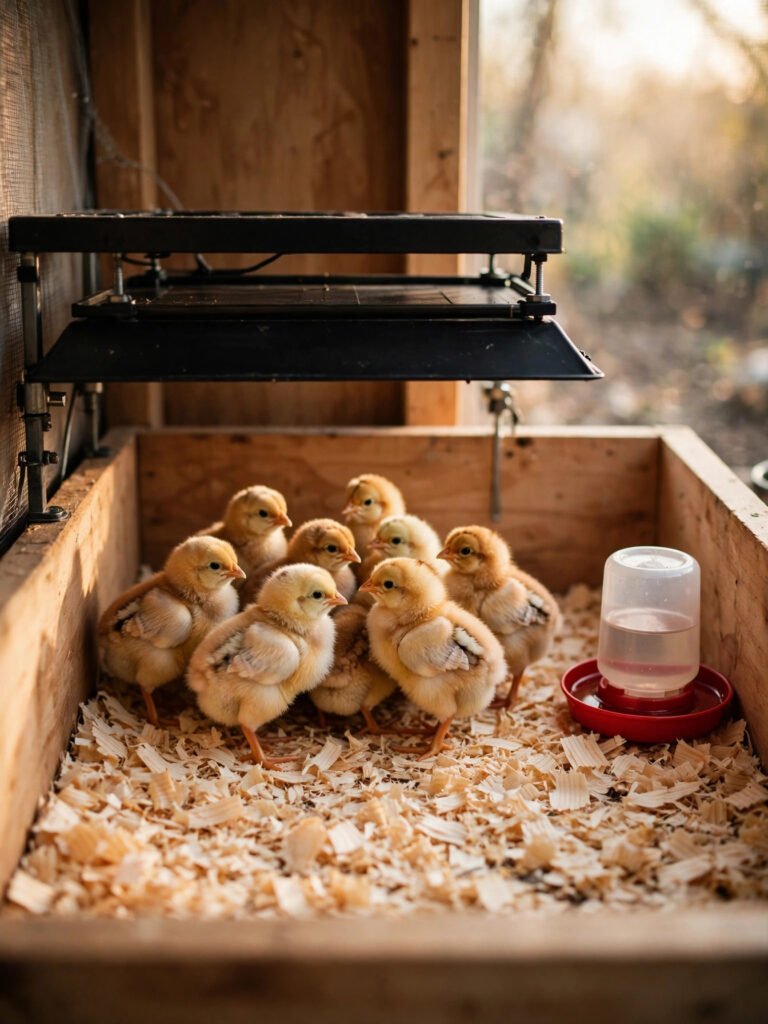
A heat plate is a flat panel on legs, warm on its underside, and it works by copying the original design. A day-old chick under a hen does not sit in heated air — she pushes up into warm feathers and takes the heat by contact. Under a plate, chicks do exactly that: they duck underneath, press their backs against the warm surface, and settle. When a chick is warm enough she wanders out to eat, drink and explore, then comes back when she cools down. The chicks run their own thermostat, the same way they would with a mother hen making the decisions.
Two quiet advantages follow from that. First, the brooder goes properly dark at night, because a plate gives off heat without light. Chicks sleep in real darkness, on a natural day and night rhythm, and keepers consistently report calmer batches under plates — no 2 a.m. cheeping chorus under a glowing bulb. Second, there is no hot spot to manage. The plate’s underside is evenly warm, so chicks spread out underneath instead of piling into the one perfect spot, and piling is how chicks get smothered. As the chicks grow, you raise the legs a notch at a time so the plate keeps sitting just above their backs — Brinsea builds its plates to tilt for exactly this, taller at the back for bigger chicks, lower at the front for the small ones.
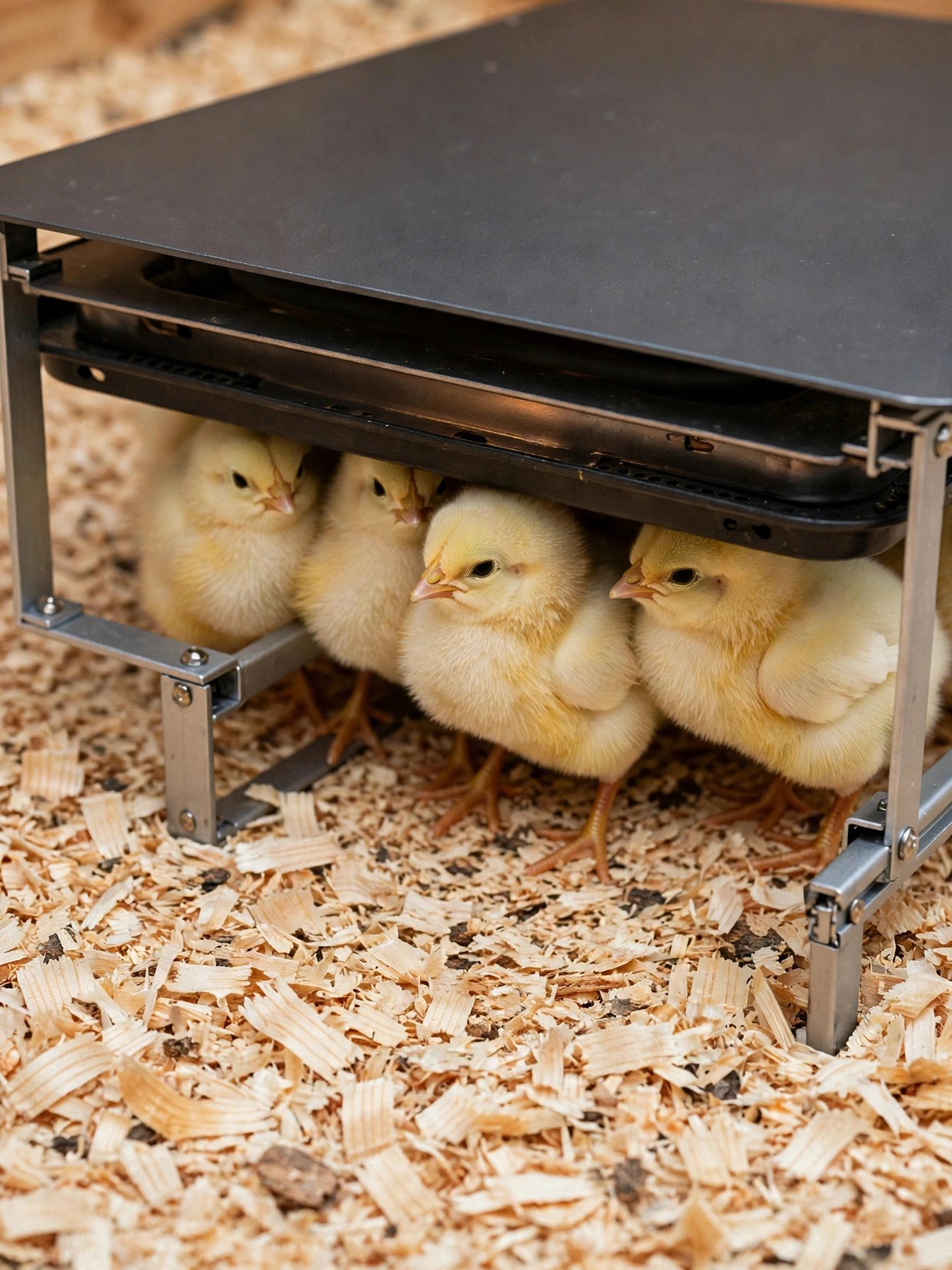
One thing plate users have to relearn: the thermometer. Under a lamp you measure air temperature and chase the number. Under a plate the air stays cool — only the chicks are warm — so a wall thermometer will never show the readings on a temperature chart, and that panics a first-timer every spring. Judge by behavior instead. Quiet chicks spread loosely under and around the plate are warm chicks. Chicks cheeping loudly and huddled in a tight ball are cold, whatever any gauge says. Our brooder temperature chart still matters — it tells you how much heat chicks need week by week, and when they need none at all.
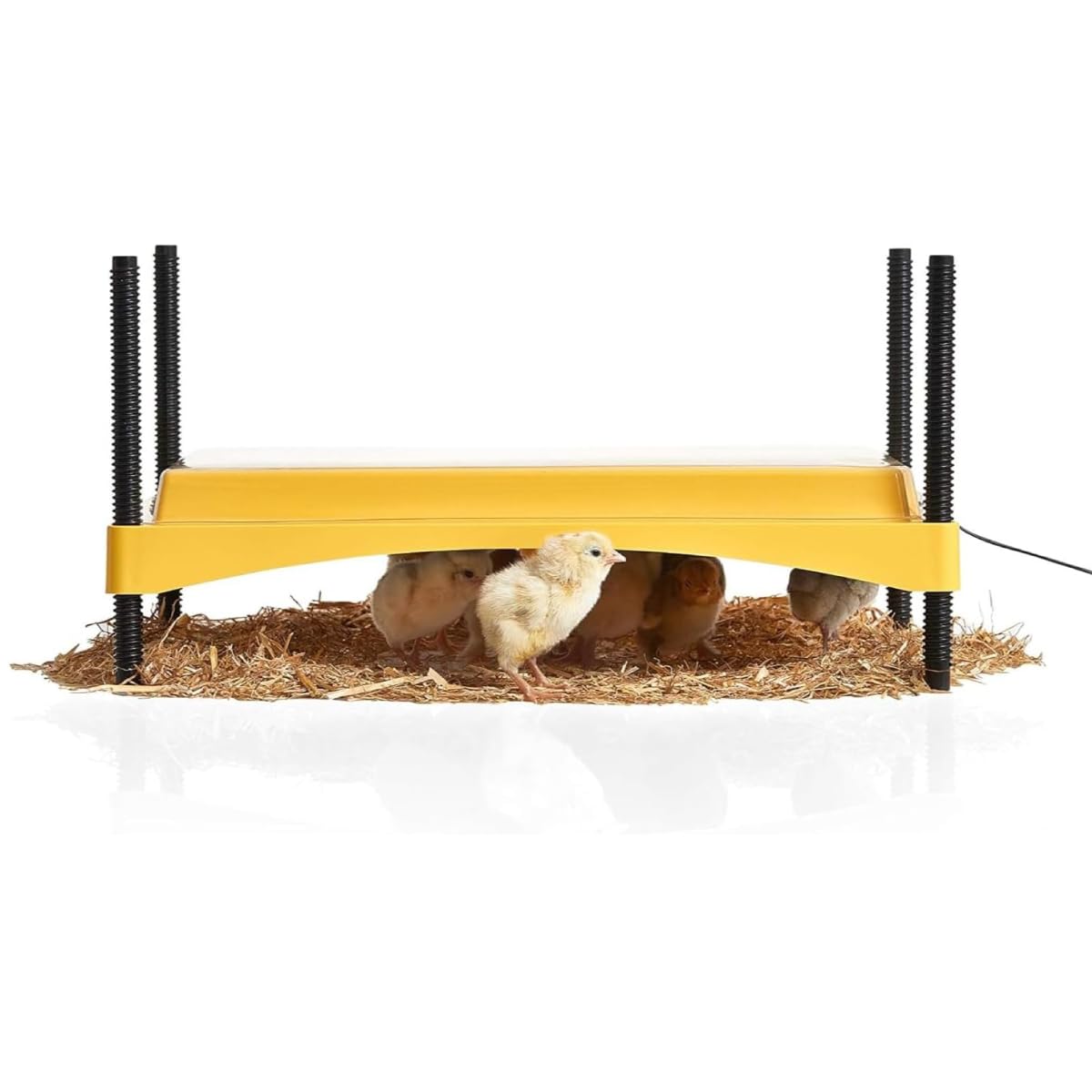
- Warms up to 35 newborn chicks (about 20 as they grow) on just 18 watts — a fraction of the electricity a 250 watt heat lamp uses
- Safe 12 volt supply, a metal warming plate that evens out hot and cold spots, and a flared skirt that holds the warmth where the chicks are
- Height and angle adjust as the chicks grow, a clear plastic cover is included, and Brinsea backs it with a 3-year warranty when registered
What we like:
- The safety design is the product. Low voltage, a plate that never gets bulb-hot, no glass hanging over bedding — the whole category exists because of fire risk, and this plate is engineered furthest from it
- Even heat, no hot spots, real darkness. Chicks spread out underneath instead of piling in one warm corner, and they sleep at night like chicks under a hen do
What holds it back:
- It warms chicks, not air. Brinsea is plain about the limit: the brooder room needs to stay above roughly 50°F for day-old chicks, especially in the first days
- Capacity is a ceiling, not a suggestion. Outgrow the plate and the answer is a second plate, which is real money next to one more bulb
- It costs more up front than basic plates working on the same idea — you are paying for build quality and the warranty
How a Heat Lamp Works
A heat lamp takes the opposite approach: instead of warming the chicks, it warms a circle of the brooder. A 250 watt infrared bulb hangs above the bedding and creates a gradient — hot in the middle, cooler at the edges — and the chicks position themselves along it, drifting toward the bulb when cold and away when warm. Done well, it works, and it has worked for generations of poultry keepers. It is also the system behind most of the fine print in this article, because the warm zone comes with a bulb hot enough to be dangerous and bright enough to change how chicks live.
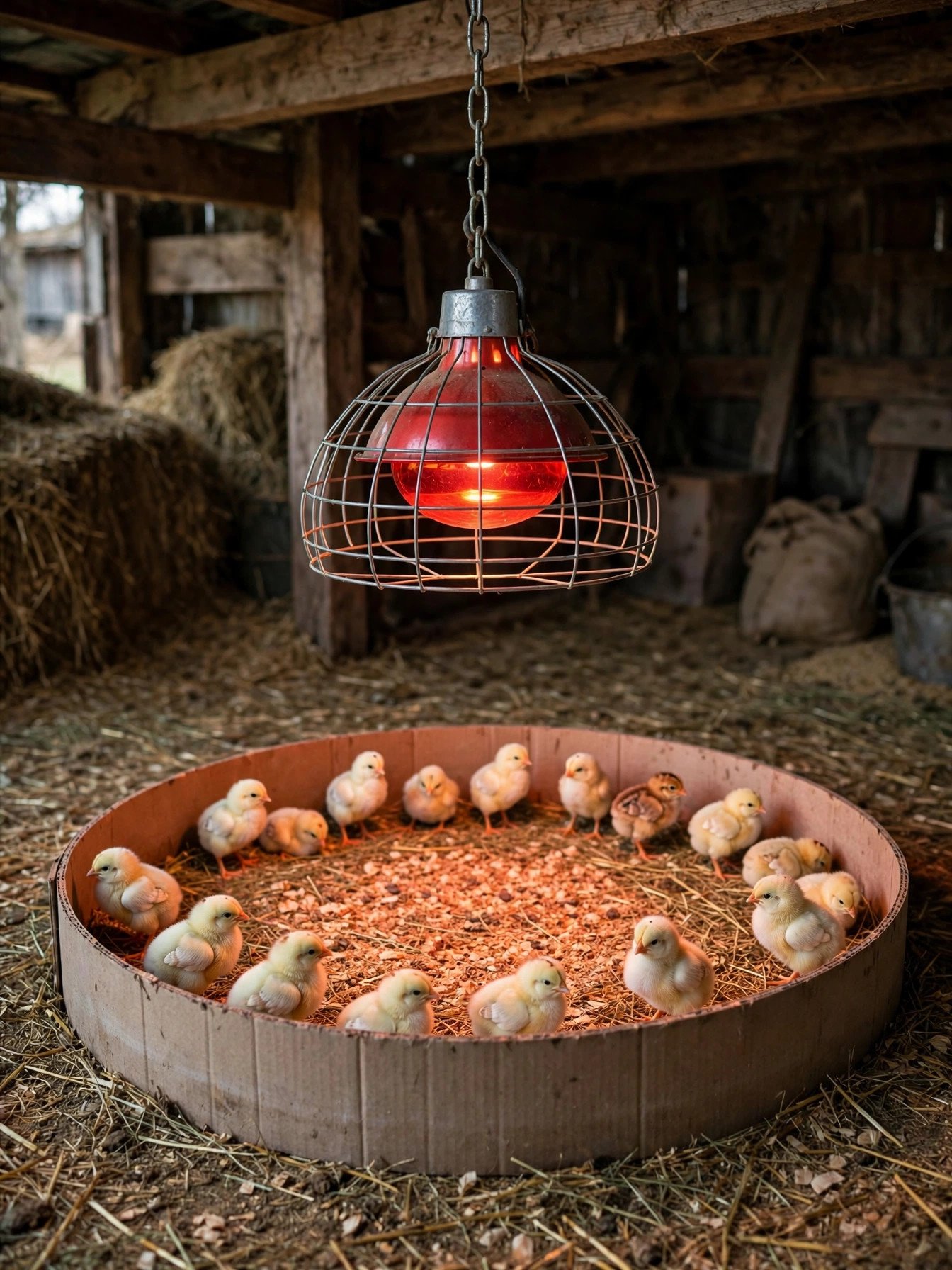
The light is the subtle problem. A clear or white bulb is daylight that never ends: chicks under one live around the clock in full brightness, with no true night to sleep in. Owners have reported restless, noisy batches and more pecking at each other under constant light for as long as these bulbs have existed, which is why red bulbs became the standard — the dim red glow bothers chicks far less and lets them rest closer to normally. Red is a workaround, though, not a solution. The bulb is still on all night, still hot, and still the only thing standing between a cold brooder and a batch of day-old chicks. And because a lamp heats air, its warmth is at the mercy of the room: open the brooder in a drafty barn and the warm circle shrinks fast.
The Fire Question, Honestly
This is the section the whole comparison turns on, so here it is without softening. Heat lamps start fires. Not in theory and not once in a blue moon — fire services, insurance investigators and poultry extension offices name heat lamps as a recurring cause of barn, coop and brooder fires every single year, and a brooder fire is the worst kind: dry bedding, wood shavings dust in the air, and animals that cannot get out. The usual stories run the same way. A clamp-on fixture slips or gets knocked, and the bulb lands in the bedding. A bulb works loose, drops, and shatters hot glass across shavings. Dust builds up on a hot bulb and smolders. Or a household bulb gets screwed into a fixture never built for the heat, and the socket melts down over a weekend. Every one of those is a normal accident, not carelessness on an epic scale — which is exactly why the risk deserves respect.
If you use a lamp anyway — and there are setups further down where it is the right tool — these are the non-negotiables, not suggestions:
- A proper ceramic socket fixture, rated for a full 250 watt heat bulb. Never a plastic socket, and never an ordinary household bulb — use a bulb made for livestock heat lamps, in a fixture built for it
- Hang it by a chain or wire, secured at two points. The clamp on a clamp lamp is a positioning aid, not a support. If the clamp is the only thing holding your lamp up, the setup is not finished
- A metal guard over the bulb, so nothing — not a fluttering chick, not a bumped fixture — can bring bedding or feathers into contact with hot glass
- Distance and cleanliness. Keep the lamp well clear of bedding, walls and water, dust it off regularly, and plug it into a sound, protected outlet with an undamaged cord — no frayed cables, no power strip dangling over shavings
Set against that list, the plate’s safety case almost makes itself. The underside of a plate is warm to your hand, not hundreds of degrees. The Brinsea above runs on a 12 volt supply, at 18 watts — there is no exposed hot surface anywhere in the system, nothing to shatter, and nothing in normal use that can ignite bedding. No electric heater on Earth is risk-zero, and a plate’s cord deserves the same once-over as any other. But it removes the ignition source itself, and that is the difference between a risk you manage and a risk that mostly is not there.
Electricity and Batch Size
Run the two systems side by side for a six week brooding season and the electricity gap is not subtle. A heat lamp burns about 250 watts, around the clock, the whole season — plates do the same job on somewhere between 15 and 60 watts depending on size, and the EcoGlow above does it on 18. That is a lamp using roughly ten times the electricity of a mid-size plate, every hour of every day, for heat that mostly warms air the chicks then wander out of. Nobody gets rich on the difference, but on a farm meter or a tight budget it is real money in words anyone can feel: the lamp is the expensive one to feed.
Batch size cuts the other way, and it is the lamp’s best argument. A plate covers the chicks that fit under it — roughly 20 to 35 depending on the model, fewer as they grow — and then it is full. Fifty chicks means two plates. A hundred means a row of them. One lamp, meanwhile, throws a warm circle wide enough for fifty chicks or more at the cost of a bulb, which is why hatcheries and anyone brooding meat birds in real numbers still reach for lamps. The honest middle ground many keepers land on: plates for the batches a backyard actually raises — six chicks, a dozen, twenty-five — and lamps, run carefully, for the batches that outgrow a plate’s footprint.
Which One for Your Brooder?
- A typical backyard batch — up to about 25 chicks, brooded in the house, garage or a shed: the heat plate, and it is not a hard call. Safer, cheaper to run, calmer chicks
- An unheated barn or outbuilding in late winter: the plate alone may not be enough, because it does not warm air. Either move the brooder somewhere the room stays above about 50°F and keep the plate, or use a lamp for its air-warming power — with every item on the safety checklist above treated as mandatory, because a barn is the highest-risk place a lamp can hang
- 50 or more chicks at once: a lamp, or a budget that honestly includes several plates. This is the case the lamp was built for
- A household with kids, pets and a brooder you check once or twice a day: the plate. Fewer things in it can go wrong while nobody is watching
- Weak electricity supply, or running costs you actually count: the plate again — it sips watts where the lamp drinks them
Whichever heat you choose, it is one part of a setup, not the whole of it — our guide to the best brooder setups for baby chicks puts the heat source into a complete brooder, box, bedding and all, and the brooder temperature chart shows how the heat comes down week by week until the chicks are feathered and done with it.
Frequently Asked Questions
Is a heat plate warm enough for day-old chicks?
Yes — provided the brooder room itself stays above roughly 50°F, which is the condition manufacturers like Brinsea state for their plates. The chicks take their heat by contact, pressing against the warm underside exactly as they would under a hen, and they come out to eat and drink in cool air quite happily. Read the chicks, not the thermometer: quiet and spread out means warm enough, loud and tightly huddled means something needs adjusting.
Can a heat lamp really start a fire in a brooder?
Yes, and it happens every year — heat lamps are a documented, recurring cause of barn and coop fires. The usual chain is ordinary: a clamp slips, a bulb drops or shatters into dry bedding, or dust cooks on hot glass until it smolders. A proper ceramic fixture, a guard, and hanging the lamp by a chain rather than trusting the clamp cut the risk a great deal — but they reduce it rather than remove it, and that difference is the core of this whole comparison.
Do chicks need light at night in the brooder?
They need heat at night, for their first weeks — they do not need light. Chicks raised by a hen sleep in darkness and thrive on the rhythm. A clear heat lamp bulb takes that darkness away, which is why red bulbs exist as a compromise. A heat plate sidesteps the question entirely: full warmth, full dark, and a batch that settles at night instead of cheeping under a bulb.
When can chicks come off heat altogether?
Generally when they are fully feathered, at around six weeks — sooner in warm weather, a little later in a cold spring. Wean them gradually either way: raise the plate a notch at a time in its last weeks, or lift the lamp higher and run it at night only before you switch it off for good. A chick that has been hardened off in steps handles the first night in the coop far better than one whose heat vanished overnight.
The Bottom Line
For the brooder most readers of this site will ever run — a batch of backyard chicks in a garage, a shed or a spare corner — the heat plate is the answer, and the safety record is the reason. It warms chicks the way a hen does, it runs on a trickle of electricity, it lets them sleep in the dark, and it takes the single most dangerous object in chick keeping off your ceiling. The heat lamp keeps two honest crowns: it warms cold air in cold buildings, and it covers very large batches for the price of a bulb. If your setup is one of those, use the lamp — and use the checklist, every item, every time. When you are stocking the rest of the brooder, our baby chick supplies checklist covers everything else the chicks will need from day one.