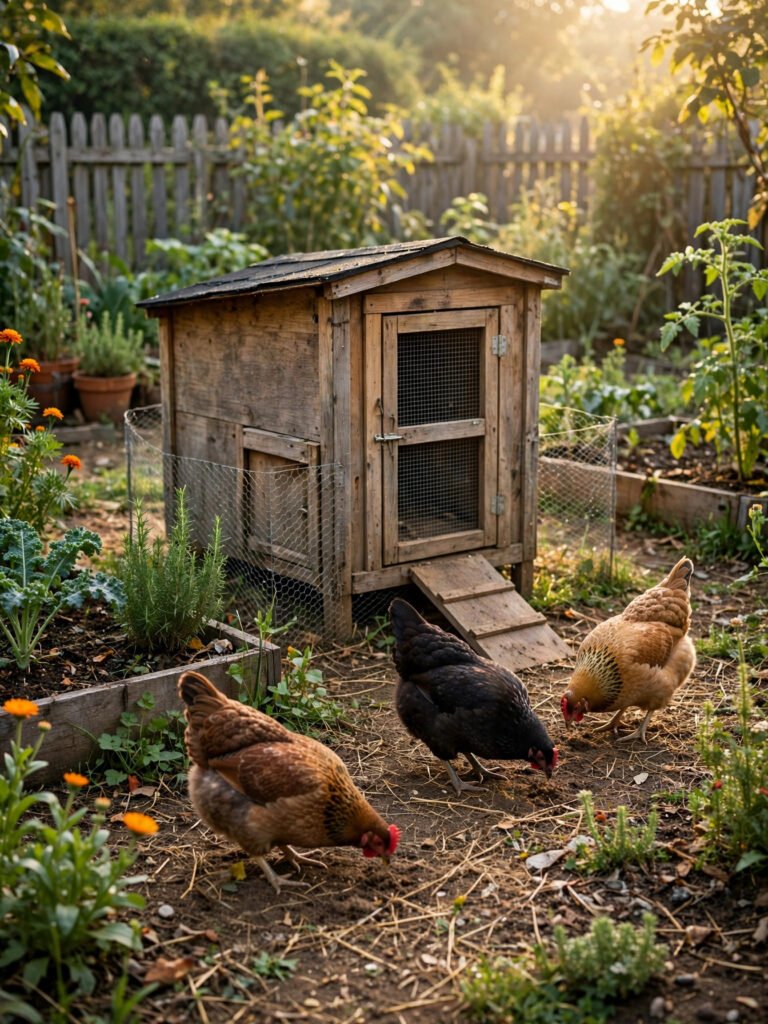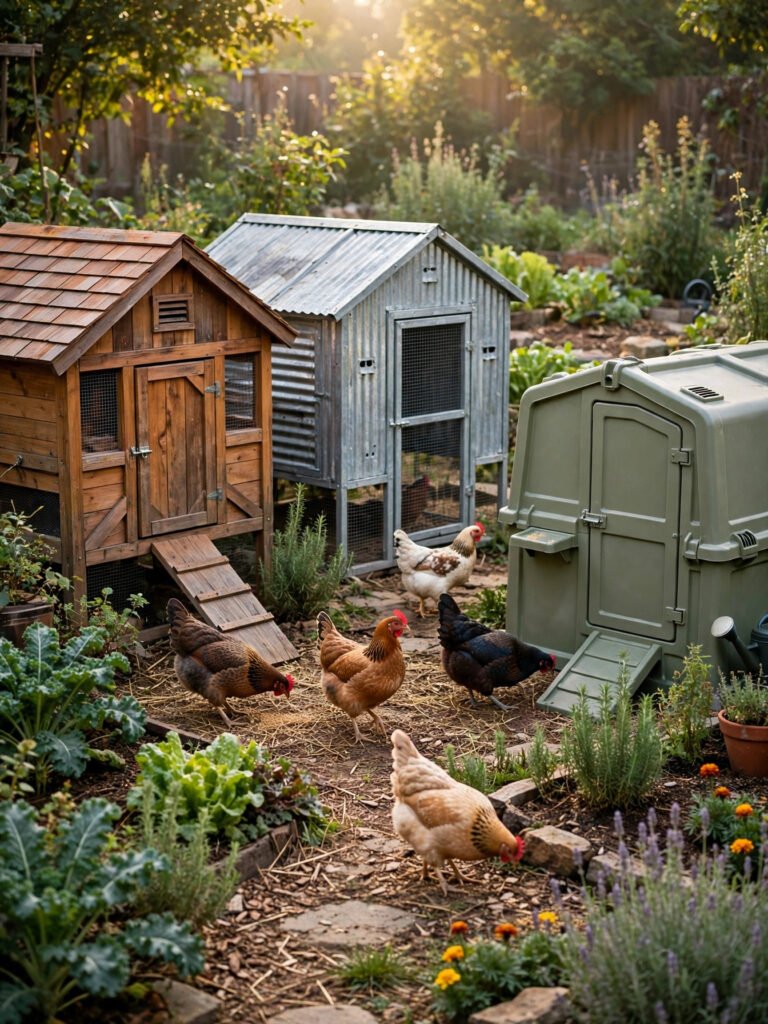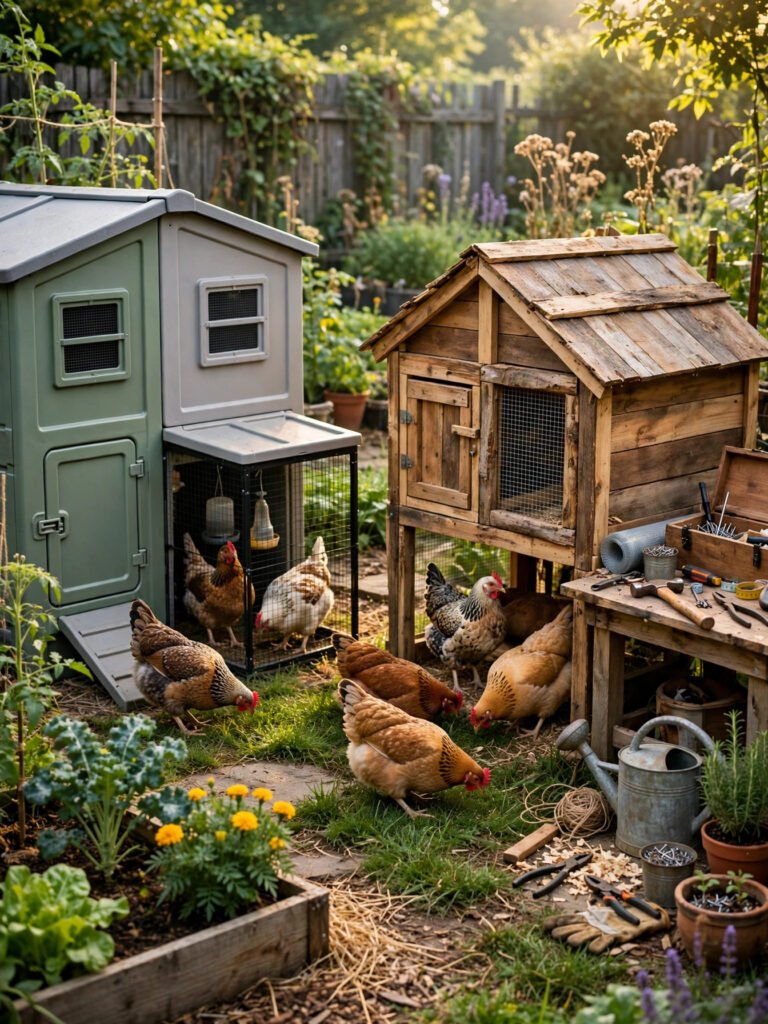
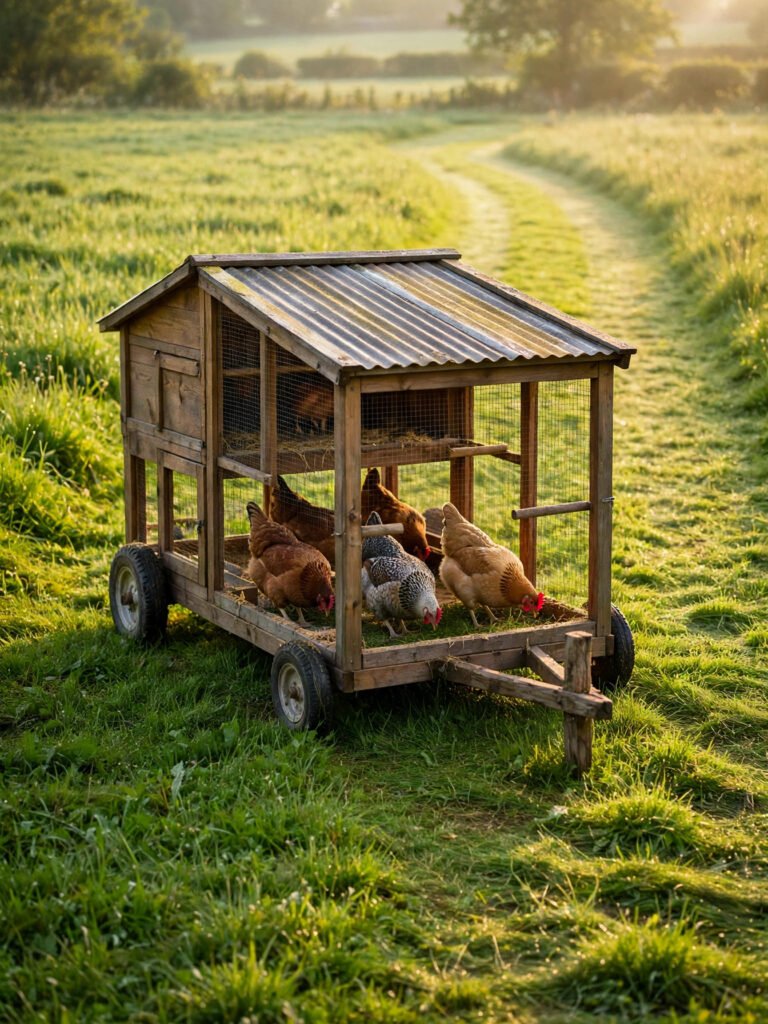

A chicken tractor is the simplest idea in chicken keeping: a floorless coop and run on wheels, so your hens get fresh grass every day and your lawn gets fertilized in neat, moving strips. But the whole idea stands or falls on one unglamorous fact — a tractor only works if you actually move it. Daily is best. Every other day is the honest limit. A tractor that sits in one spot for a week is not a tractor anymore; it is a small, crowded coop parked on dead mud, with the smell to prove it.
So this guide judges mobile coops the way you will actually live with them. Every pick was chosen from manufacturer specs and the patterns that show up again and again in verified owner reviews — we do not claim to have tested these tractors in our own yard. Three things decided the list. Footprint: with no separate run, the ground under the tractor is the hens’ whole world, and most tractors honestly fit 3 to 5 hens whatever the box says. Wheels: the design is the difference between a two minute job you will do daily and a back injury you will start avoiding. And predators: a tractor is not predator proof the way a fixed coop with a buried hardware cloth skirt is, and we will say exactly why below.
Quick Picks: The Short Version
| Tractor | Footprint | Realistic hen count | Move style |
|---|---|---|---|
| Aivituvin 83in Mobile Coop (AIR61) | 83.3 × 26 in — about 15 sq ft of ground | 3 hens (4 small hens, moved daily) | Lockable caster wheels + pull handle |
| GUTINNEEN 85in Coop with Iron Frame Run | 85.6 × 40.6 in — about 24 sq ft of ground | 4 hens (5 with daily moves) | Caster wheels under the house |
| PetsCosset 77.4in Mobile Coop | 77.4 × 25.6 in — about 14 sq ft of ground | 3 hens | Two wheels + lift handle |
| MEDEHOO 82.4in Mobile Coop (AIR72) | 82.4 × 25.8 in — about 15 sq ft of ground | 3 hens per unit | Lockable caster wheels |
1. Aivituvin 83in Mobile Coop (AIR61) — Best All-Rounder
If you have browsed mobile coops at all, you have seen this design — on sale since 2021, which in kit coop years makes it a senior citizen, with the deep pool of owner reviews that comes with time. The layout is the classic one: raised wooden house at one end, ground run underneath and out front, nesting box, perch, ramp and a pull out tray. What earns it the top spot is the moving gear: lockable caster wheels and a pull handle, so one person can roll about 80 pounds of coop onto fresh grass and lock it in place.

- 83.3 × 26 inch footprint — about 15 sq ft of ground, with the seller putting total inner space at 18.5 sq ft counting the raised house floor
- Lockable caster wheels and a pull handle: a genuine one person move, and it stays put on a slope
- Nesting box, perch, ramp and removable tray all included; about 80 pounds all in
- Sold for 4 to 6 hens; by tractor math it is a comfortable 3, or 4 small hens moved every day
What we like:
- The casters lock. A detail, until your coop slowly rolls itself downhill on a windy night. Locked wheels plus a handle is the setup owners praise most
- Years of owner reviews to learn from. This design’s weak points are known quantities, not surprises — and none are fatal
- The basics are all in the box: tray, ramp, perch, nesting box. Nothing else to buy before the hens move in
What holds it back:
- At about 80 pounds it rolls happily on a flat lawn and argues on slopes, ruts and wet ground
- It is 26 inches wide, like almost every kit tractor. The run is a corridor, not a yard — hens can pass each other, but there is no getting away from a flock mate in a mood
- Fir panels, the usual story: a coat of exterior sealant before the first winter is close to mandatory
Not for: flocks of five or six, whatever the listing says, or anyone whose only ground is a slope. For: the classic suburban setup — three hens, a flat lawn, and a keeper who will enjoy the daily two minute roll.
2. GUTINNEEN 85in Coop with Iron Frame Run — Most Ground Space
Every other tractor in this guide is about 26 inches wide. This one is 40.6 inches wide, and that single number changes how the birds live. The GUTINNEEN pairs a wooden house — on caster wheels, with a pull out tray and ventilation windows — with a big iron frame run under a weatherproof cover: about 24 square feet, roughly 60 percent more ground than the standard kit tractors. And width is the space hens actually use: room to pass, room to dust bathe side by side, room for the lowest hen to be somewhere else.

- 85.6 × 40.6 inch footprint — about 24 sq ft of ground, the most in this guide by a wide margin
- Wooden house on caster wheels, iron frame run that will not rot, and a weatherproof cover for shade and rain
- Pull out tray, non slip ramp, ventilation windows and a nesting box included
- Realistically 4 hens living in it full time, 5 if the daily move never slips
What we like:
- The width. Four hens in 24 square feet live noticeably better than four hens in 15 — you will see it in how little squabbling there is at the feeder
- A metal run frame. The run lives in the weather and takes the knocks; iron outlasts thin fir framing
- The covered run means a rainy week does not turn the whole living space into soup — the hens keep a dry corner
What holds it back:
- Size cuts both ways. Nearly 7 feet by 3.5 feet is a lot of coop to shift, and on anything but flat lawn the daily move is honestly a two person job — which is exactly how tractors stop getting moved
- The listing puts the run’s gap size at just under an inch. That keeps hens in, but it is not the half inch hardware cloth we tell people to aim for
- The weatherproof cover is fabric. Expect it to age faster than the frame under it
Not for: small yards — measure before you fall for the space — or a solo keeper on rough ground. For: four hens, a flat lawn, and two people sharing the daily move.
3. PetsCosset 77.4in Mobile Coop — The Lightest Lift
The PetsCosset takes the other road on wheels: instead of four small swivel casters, it runs on two wheels at one end with a pull handle, wheelbarrow style. Lift the light end, roll it forward a body length, set it back down flat on the grass. The brand’s own comparison chart puts its 78 inch models at about 54 pounds — the lightest in this guide — and the design has a quiet advantage nobody puts in the listing: parked, the frame sits flush on the ground, with no caster holding one edge up and leaving a gap underneath.

- 77.4 × 25.6 inch footprint — about 14 sq ft of ground, and around 54 pounds by the brand’s own chart
- Two wheels and a pull handle: lift one end and roll, then the frame sits flat and gap free when parked
- Asphalt roof over the house, clear panels over part of the run for light, nesting box, roosting bars and an oversized pull out tray
- Sold for 2 to 6 hens; honestly 3, which is the right size for it
What we like:
- Two fixed wheels roll straighter than four small casters on real grass. Casters swivel, dig in and fight you on bumps; this just rolls — the move you are least likely to start skipping
- It parks flat. No raised edge, no daylight gap under the frame for a raccoon to work on — a small thing that matters in the predator section below
- The tray is oversized, and the clear run roof lets in light without letting in rain
What holds it back:
- You are the other wheel. Even at 54 pounds, lifting one end of a loaded coop daily is a lift, and it will not suit every back
- Clear roof panels over the run can greenhouse on a hot, still day. Park it so the hens keep shade, and watch it in a heatwave
- Some owners of the brand’s coops report the size running slightly smaller than listed — measure on delivery day, while returns are easy
Not for: anyone who cannot lift, or a flock bigger than three. For: two or three hens on a smaller lawn, moved a short distance every day.
4. MEDEHOO 82.4in Mobile Coop (AIR72) — The Expandable Pick
The MEDEHOO is the same proven shape as the Aivituvin — raised house, ground run, casters, tray — with two twists worth knowing about. The nesting box has a removable divider, so it can be one big box or two singles, which matters because hens argue about nesting boxes with a seriousness nobody expects. And the coop is built to join: two units connect end to end, so a flock of three can become a flock of six in a doubled tractor instead of a whole new purchase. Bought singly, it is an honest 3 hen tractor. As a pair, it is one of the few honest routes to six in a tractor at all.

- 82.4 × 25.8 inch footprint — about 15 sq ft of ground per unit
- Lockable caster wheels, pull out tray and a weatherproof asphalt roof
- Sectionable nesting box: removable divider makes it one large box or two singles
- Two units join end to end as the flock grows; sold for 4 to 6 hens, honestly 3 per unit
What we like:
- The divider nesting box solves a daily irritation — one hen brooding in the only box while another does an urgent dance outside it
- Chicken math, planned for. Doubling the tractor later beats selling a too small coop and starting again
- The familiar shape means the weak points and fixes of the whole AIR style family are well documented in reviews
What holds it back:
- The “4 to 6 chickens” in the title is the usual kit optimism. Three hens live well in one unit; six would be a crowd, full stop
- Small casters again — fine on a mowed lawn, reluctant on soft or rutted ground, and the whole system depends on the move staying easy
- Fir construction, and a roof that wants checking each spring. Budget the sealant and the hour
Not for: a firm flock of five or six in a single unit. For: a starter flock of three whose keeper already suspects it will not stay three.
How Much Space in a Tractor? The Honest Numbers
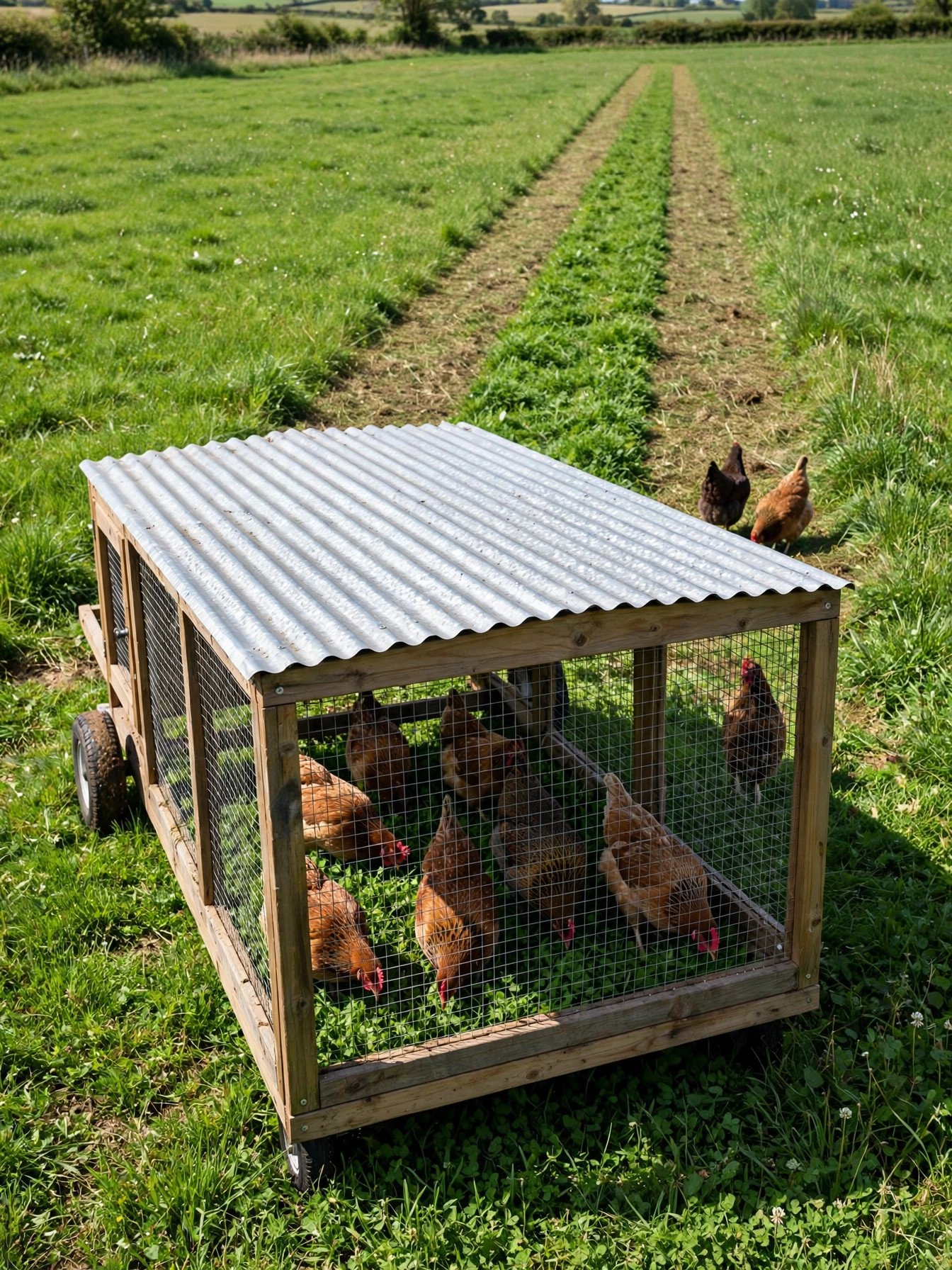
Tractor math is different from coop math. In a fixed setup, a hen needs 4 square feet inside the coop and 10 square feet in the run — but that run figure assumes the same ground, day after day, getting scratched bare and worse. A tractor’s ground is fresh every morning, which is why birds in daily moved tractors do well at the lower edge of the range. The working rule we use: about 5 square feet of ground per hen, minimum, if the tractor moves every single day — and back up toward 10 if your moves sometimes slip to every second or third day.
Run the picks above through that rule and the table explains itself: 15 square feet is a 3 hen tractor, 24 square feet is a 4 to 5 hen tractor, and no 26 inch wide kit honestly houses eight. One more number still applies inside: the raised house floor is where hens sleep, so roost space still rules the night — about 10 inches of bar per hen. If you are between sizes, our free Coop Size Calculator runs the fixed coop numbers for the same flock, so you can see what your hens would need if the tractor ever stops moving.
Wheels, Weight and Your Back
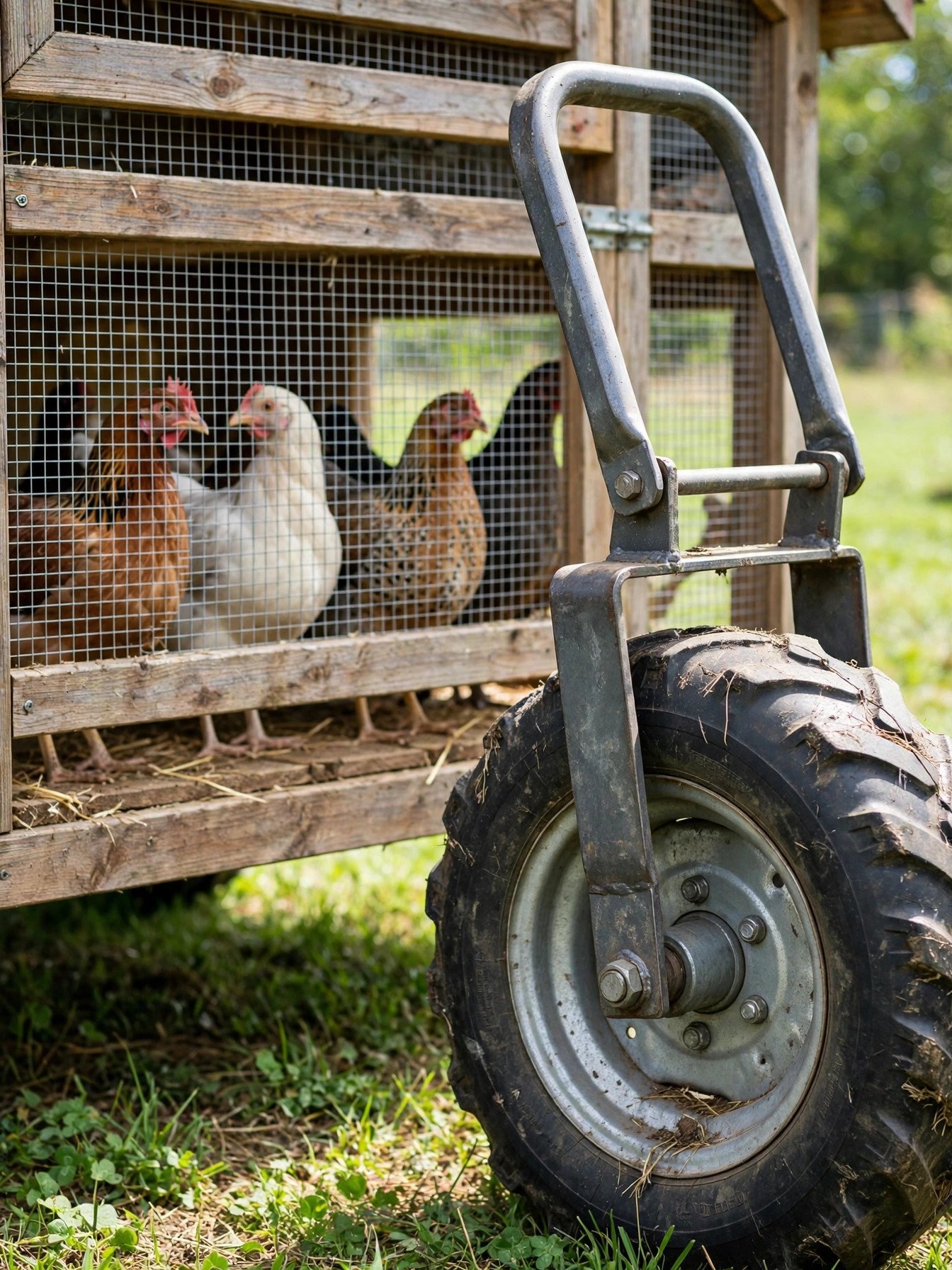
Here is the review pattern that matters most in this guide: nobody gives up on a tractor because the nesting box was the wrong shape. They stop moving it — which is the same failure — because the move was miserable. Three designs exist. Four swivel casters (the Aivituvin and MEDEHOO) roll in any direction and lock in place: wonderful on a flat, mowed lawn, stubborn on bumps, where little wheels dig in and swivel sideways. Two fixed wheels and a handle (the PetsCosset) rolls straight over rough grass and parks dead flat, at the cost of a daily lift. Drag designs with no wheels appear at the cheap end of the market; skip them entirely, because a coop you drag is a coop you will leave standing.
Weight is the other half of it. These kits land between roughly 54 and 85 pounds before hens, feed and a waterer add another 20 or so. On flat ground that rolls; on a slope or in mud, it pulls. Before you buy, walk your intended route with the mower — if the mower struggles there, the tractor will too. Then plan a simple loop, moved one tractor length a day, so the coop is not crossing its own old ground inside a fortnight.
Tractors and Predators: The Honest Weak Point
Now the part the listings skip. A fixed coop can be wrapped in a hardware cloth skirt that runs underground or out across the soil, so a digging raccoon or fox hits wire wherever it digs. A tractor cannot have one — the skirt is exactly what would stop it moving. What it has instead is a bottom edge, and on real, lumpy lawns that edge has gaps. A determined predator works those gaps; a strong one tests whether it can lift a corner; and a tractor parked in one spot for days gives it time to try. Add that most kit tractors use welded wire or chicken wire rather than half inch hardware cloth, and the honest picture is this: a tractor is a daytime grazing system with a lockable house, not a fortress.
You manage that risk rather than eliminate it. Move daily — fresh ground also means a moving target. Park on your flattest ground and walk the edge after each move: if you can slide your fingers under the frame anywhere, so can a raccoon. Lock the hens inside the raised house at night, and upgrade any simple sliding latch, because raccoons open those like toddlers open cupboards. Our full guide to how to predator proof a chicken coop covers latches, mesh and skirts in detail — apply everything except the skirt. And be straight with yourself about your area: if foxes patrol your garden in daylight, no tractor is the right answer, and a fixed house with a proper run is.
Frequently Asked Questions
How often do you really need to move a chicken tractor?
Every day is the real answer, and every other day is the honest limit. Hens strip and manure a patch of grass fast; by day three the ground is going backwards and the fresh grass benefit — the entire reason the tractor exists — is gone. If your life only allows a move twice a week, size the tractor as if it were a fixed run, at close to 10 square feet per hen.
How many chickens fit in a chicken tractor?
For the kit tractors sold online, three to five — not the six to eight in the product names. Work it out from the footprint: divide the ground area by about 5 square feet per hen if you will move it daily, or by 10 if you will not. A typical 82 × 26 inch tractor has about 15 square feet of ground, which makes it a 3 hen home. Sellers reach their numbers by counting the raised house floor too, and allowing half the space per bird.
Are chicken tractors safe from predators?
Safer than free ranging, weaker than a fixed coop — that is the honest ordering. A tractor has no floor and no buried skirt, so its weak points are gaps under the bottom edge on uneven ground, and mesh that is often lighter than hardware cloth. Moving daily, parking flat, locking hens into the house section at night and upgrading the latches closes most of that gap. In high predator country, choose a fixed coop instead.
Chicken tractor or fixed coop and run — which is better?
They solve different problems. A tractor gives hens genuinely fresh ground and spreads manure across your lawn for free, and it suits small flocks — six hens is about the practical ceiling. A fixed coop and run gives more space per bird, real predator proofing, and room to grow; if your flock might reach eight or ten, look at our guide to the best walk in chicken coops instead. Many keepers end up with both: fixed setup as home base, tractor as the summer grazing pen.
The Bottom Line
Buy a tractor for the move you will actually make. If that is a short daily roll on a flat lawn with three hens, the Aivituvin AIR61 is the proven default, and the lighter PetsCosset makes the move easier still. If your flock is four and your lawn can take the width, the GUTINNEEN’s 24 square feet is the most living space on wheels here. And if chicken math is already whispering to you, the MEDEHOO’s join two design grows with it. Whichever you choose: divide the footprint before you believe the name, lock the hens in the house at night, and move it tomorrow. Then move it again the day after. That is the whole secret of the thing.